



On 1 April 2026, the biggest changes to the NHS dental contract in more than twenty years came into force. The reforms are supposed to make it easier to get an urgent appointment, give dentists a stronger reason to treat patients with complex problems, and push more NHS funding towards the people who need it most.
If you have spent the last few years phoning round London practices and being told the list is closed, you will want to know whether any of this actually changes things for you. Here is what has changed, what it means in practice, and how to use it to get seen. For a full breakdown of what you will pay, see our NHS dental charges 2026 guide.
What has actually changed
The Department of Health and Social Care published its response to the NHS dental contract consultation in December 2025, and the new rules took effect on 1 April 2026. Four things matter most for patients:
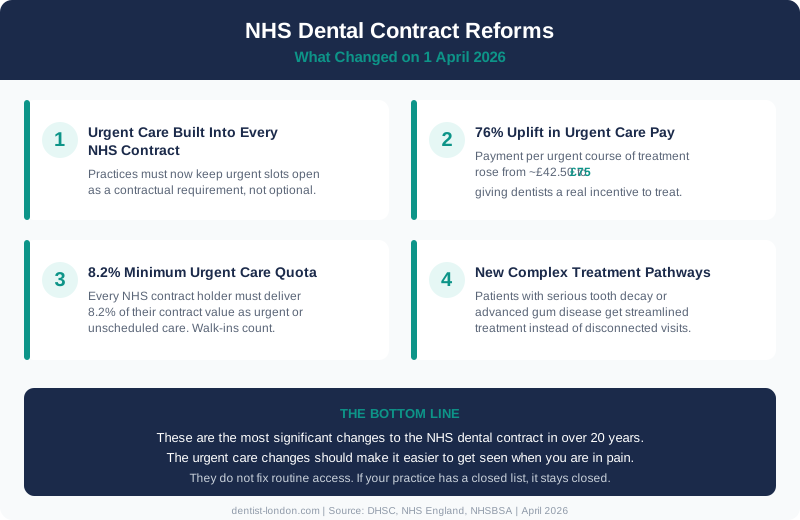
- Urgent care is now built into the NHS dental contract. Every general NHS dental contract holder has to deliver a set amount of urgent or unscheduled care as part of their core commitment.
- Payment for urgent care has gone up sharply. Dentists are now paid £75 for each urgent course of treatment, which is a 76 per cent increase on the old rate.
- Complex treatment pathways have been redesigned. Patients with serious tooth decay or advanced gum disease are meant to be treated through new pathways rather than spread across several disconnected appointments.
- Practices have a minimum urgent care quota. NHS dental contractors are required to deliver 8.2 per cent of their contract value as urgent or unscheduled activity in 2026/27.
The headline change is the urgent care part. For years, dentists had almost no financial reason to keep slots open for patients in pain, because urgent treatment paid the same as a routine check-up under the old units of dental activity system. That is what the government is trying to fix.
What urgent care now means for you
If you have severe tooth pain, a dental infection, swelling, a knocked-out tooth, bleeding you cannot stop, or a broken tooth causing real pain, you should now find it easier to get seen on the NHS. Practices have a contractual quota to fill, and they are paid £75 for each urgent course of treatment rather than being penalised for fitting you in. For same-day situations, our emergency dentist London page lists practices with urgent capacity.
The important nuance is that urgent care is not the same as routine care. Getting seen urgently does not mean you have been accepted as a regular NHS patient at that practice. If your tooth needs a crown or a full course of treatment after the emergency is stabilised, you may still be referred back to find your own NHS dentist in London for ongoing care.
How to access urgent NHS dental care in London
The process in London has not changed, but the reforms are meant to make the second step work more reliably than it used to:
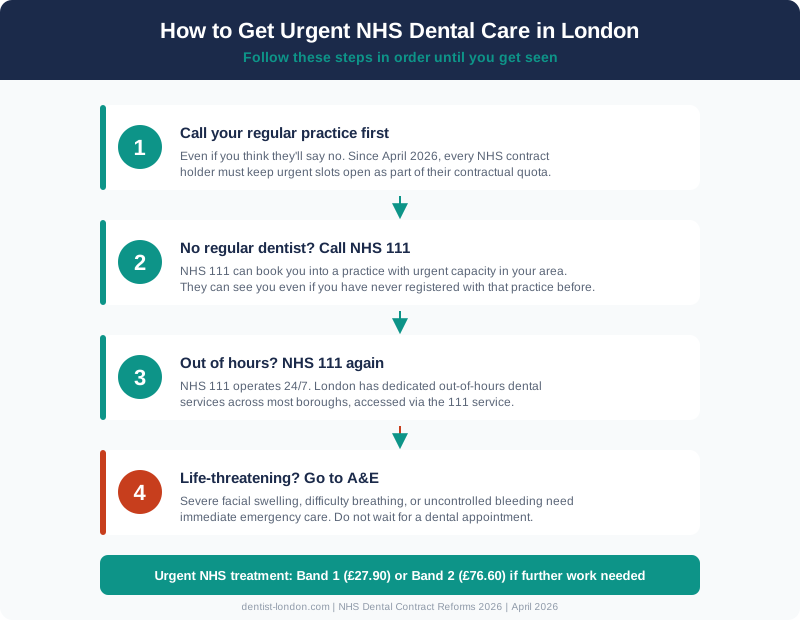
- Call your regular practice first, even if you are not sure they will see you. Practices that hold general NHS dental contracts now have an urgent care quota to fill.
- If you do not have a regular dentist, call NHS 111. They can book you into a practice with urgent capacity in your area.
- Out of hours, NHS 111 is still the main route. London has dedicated out-of-hours dental services operating across most boroughs.
- For life-threatening problems such as severe facial swelling, breathing difficulty, or uncontrolled bleeding, go to A&E immediately.
Walk-in urgent patients, patients referred by NHS 111, and patients already registered at the practice all count towards the practice’s urgent care quota, so you should not be turned away on the grounds that you have never been there before.
What the reforms do not fix
It is worth being honest about the limits. The reforms address urgent access and complex treatment, but they do not directly solve the bigger problem most London patients face, which is finding an NHS dentist willing to take them on for routine care.
Practices still set their own policies on accepting new NHS patients for check-ups, hygienist visits, and ongoing care. If your local practices have closed lists, the new contract does not force them to reopen those lists. It only requires them to take a share of urgent cases.
The government describes this as the first step towards a new NHS dentistry model rather than the finished article. Further workforce and commissioning changes are expected through 2026 and 2027. For a borough-by-borough picture of where NHS access is hardest to come by, see our analysis of London dental deserts in 2026.
What to do if you still cannot get seen
If you have tried your local practices and NHS 111 and you are getting nowhere, these steps are worth taking:
- Widen your search to neighbouring boroughs. NHS availability varies street by street across London. A resident in Tower Hamlets may find availability in Hackney or Lewisham, where adult access rates are considerably higher. The borough next to yours may have very different capacity.
- Ask to be added to waiting lists even at practices that are currently closed. Capacity shifts through the year, and practices with NHS contracts do take on new routine patients when slots open up.
- Keep a record of each practice you have contacted, the date, and what they said. If you need to raise a formal complaint with your Integrated Care Board, this record will matter.
- For non-urgent problems, private practices will almost always see you faster. It is not a solution for everyone, but it is worth knowing the cost before you dismiss it.
Frequently asked questions
Do I still need to pay for NHS urgent care?
Yes, unless you qualify for free NHS dental treatment. Urgent care is charged under the standard NHS band system. Around half of NHS dental patients qualify for free treatment, including under-18s, pregnant women, new mothers in the first year after birth, and people on qualifying low-income benefits.
How much does urgent NHS dental care cost?
Urgent care falls under Band 1, which is £27.90 for a course of treatment from April 2026. If your urgent problem requires further treatment such as a filling or extraction, that may be charged at the Band 2 rate of £76.60.
Can I get an urgent NHS appointment if I have never registered at a practice?
Yes. Under the reformed contract, practices have to treat urgent patients regardless of whether those patients are already registered. You can either call practices directly or be referred through NHS 111.
What counts as an urgent dental problem?
Severe pain, infection, trauma to the teeth or gums, uncontrolled bleeding, and any problem causing significant swelling are all considered urgent. Routine check-ups, whitening, cosmetic work, and long-standing problems that are not currently causing pain are not urgent.
Medical disclaimer: The information on this page is for general guidance only. It is not a substitute for advice from a qualified dentist. Always consult a qualified dentist about your individual circumstances.
Cost disclaimer: NHS dental charges are set by the Department of Health and Social Care and apply across England. Private prices vary between practices. Contact the practice directly for a personalised quote.
Dentist-London.com monitors NHS dental contract updates and verifies practice information regularly. See our about page for editorial and data standards. Last reviewed April 2026.