



NHS dental charges for 2026/27 came into effect on 1 April 2026 and will stay in place until the end of March 2027. If you are booking an NHS dental appointment in London, here is exactly what you will pay, what each band covers, and who qualifies for free treatment.
This page also compares NHS charges with typical private prices across London, so you can see the real cost difference before you decide which route to take. For context on the wider reform changes that took effect alongside these charges, see our guide to the NHS dental contract reforms 2026.
NHS dental charges 2026/27 at a glance
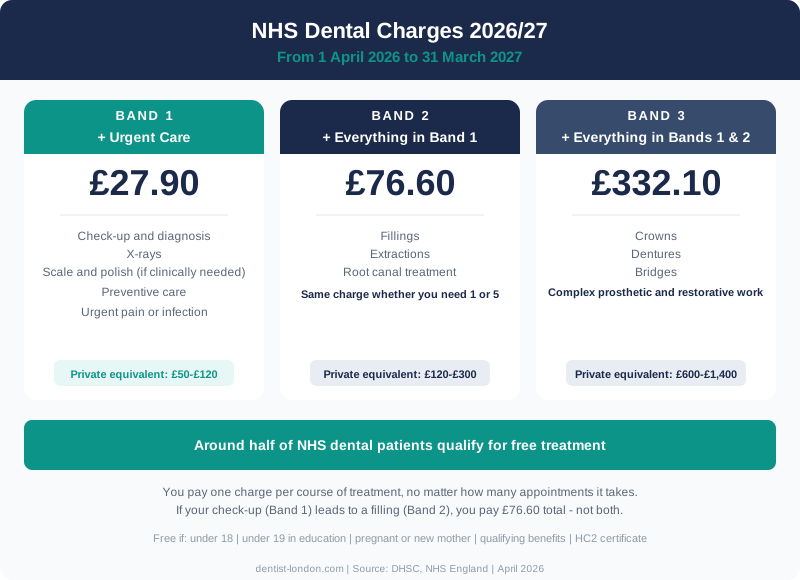
NHS dentistry in England uses a three-band system. You pay one charge for each course of treatment, no matter how many appointments that course involves. The bands for 2026/27 are:
Band 1 and urgent care: £27.90. Covers a check-up, diagnosis (including X-rays), advice, a scale and polish if clinically needed, and preventive care such as fluoride application. Urgent treatment for pain or infection also falls under Band 1.
Band 2: £76.60. Covers everything in Band 1 plus additional treatment such as fillings, extractions, and root canal work.
Band 3: £332.10. Covers everything in Bands 1 and 2 plus more complex work such as crowns, dentures, and bridges.
You only pay the band that matches the highest level of treatment in your course. If your check-up (Band 1) leads to a filling (Band 2), you pay £76.60 total, not £27.90 plus £76.60.
What counts as a course of treatment
A course of treatment is everything your dentist agrees to do from one check-up through to the point where your problem is resolved, even if it takes several appointments. You pay once at the start or end of the course, not per visit.
If you need further work later — for example, a filling six months after your check-up because something new has developed — that is a new course of treatment and a new charge.
Who qualifies for free NHS dental treatment
Around half of NHS dental patients in England pay nothing for their treatment. You will get free NHS dental care if you are under 18; are under 19 and in full-time education; are pregnant or have had a baby in the last 12 months; are an NHS inpatient treated by a hospital dentist; receive Income Support, Income-based Jobseeker’s Allowance, Income-related Employment and Support Allowance, or Pension Credit Guarantee Credit; receive Universal Credit and meet the earnings criteria; hold a valid NHS tax credit exemption certificate; or hold a valid HC2 certificate under the NHS Low Income Scheme.
If you hold an HC3 certificate, you may get partial help with costs. Always take proof of your exemption to the appointment, because you can be asked to pay the full charge and reclaim it later if you do not.
How London private dental prices compare
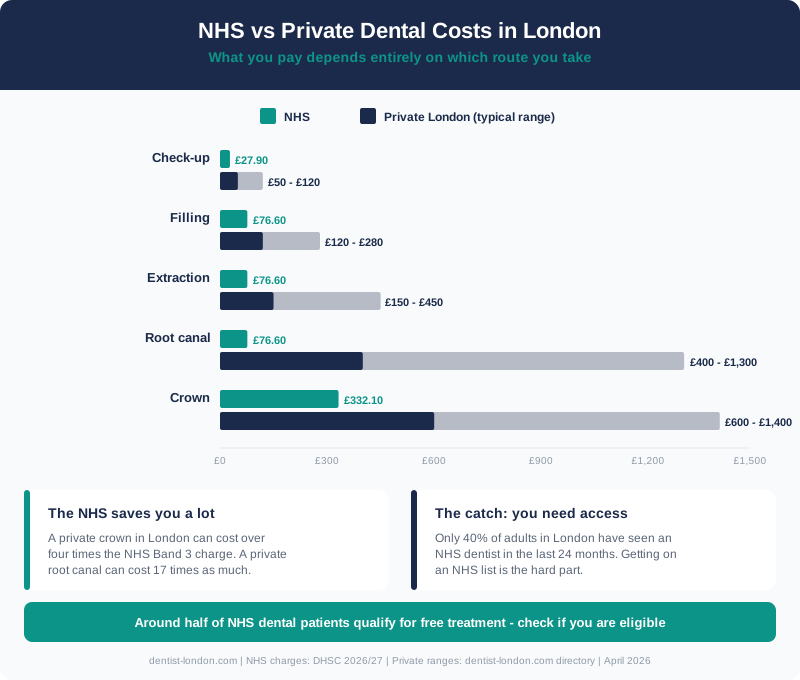
Private dental prices vary significantly across London. The ranges below are typical for private practices in the capital based on our directory data. They are not a like-for-like match with NHS bands, because private treatment covers materials and techniques that are not always available on the NHS.
Check-up and hygiene: NHS Band 1 £27.90. Private check-up in London: typically £50 to £120. Private hygienist visit: typically £60 to £120.
Fillings: NHS Band 2 (includes the filling plus check-up) £76.60. Private composite filling in London: typically £120 to £280.
Extractions: NHS Band 2 £76.60. Private simple extraction in London: typically £150 to £300. Private surgical extraction: typically £250 to £450.
Crowns: NHS Band 3 £332.10. Private crown in London: typically £600 to £1,400 depending on material.
Root canal treatment: NHS Band 2 £76.60. Private root canal (front tooth) in London: typically £400 to £700. Private root canal (molar): typically £750 to £1,300.
The NHS price advantage is real and often substantial. The trade-off is access: routine NHS appointments at practices with open lists are scarce across much of London. Boroughs such as Richmond upon Thames and Westminster have some of the lowest NHS availability rates in the capital, while Lewisham and Hammersmith and Fulham tend to have significantly better access. Some materials — for example, white fillings on back teeth — are not always available on the NHS.
What to do if you are told there is no NHS availability
If your usual practice tells you they have closed their NHS list, a few things are worth trying:
- Ask whether they are taking urgent NHS patients. Since April 2026, practices with NHS contracts are required to deliver a set amount of urgent care each year, so urgent dental care may still be available even if the routine list is closed.
- Phone NHS 111, who can direct you to practices with current urgent capacity in your area.
- Check neighbouring boroughs. NHS availability varies street by street across London, and a practice two tube stops away may have very different capacity. Our analysis of London dental deserts in 2026 breaks this down borough by borough.
- Ask to join the waiting list for routine care even if the list is officially closed. Places open up through the year.
Frequently asked questions
How much is an NHS dental check-up in 2026?
A routine NHS dental check-up in 2026/27 is £27.90 under Band 1. That covers the examination, X-rays if needed, and a scale and polish if your dentist judges it clinically necessary.
How much is an NHS filling in 2026?
A course of NHS dental treatment that includes one or more fillings is £76.60 under Band 2 in 2026/27. The charge is the same whether you need one filling or several, and it also includes the check-up.
How much is an NHS crown in 2026?
A course of NHS treatment that includes a crown is £332.10 under Band 3 in 2026/27. This covers the crown itself along with any Band 1 and Band 2 work done as part of the same course.
Do children pay for NHS dental treatment?
No. NHS dental treatment is free for anyone under 18, and for under-19s in full-time education.
Are dental charges the same everywhere in England?
Yes. NHS dental charges are set nationally and apply to every NHS dental practice in England, including every practice in London. Private prices are not regulated and vary by practice.
Cost disclaimer: NHS dental charges are set by the Department of Health and Social Care and correct for the 2026/27 financial year (1 April 2026 to 31 March 2027). Private prices are indicative ranges based on our directory data and vary between practices. Contact the practice directly for a personalised quote.
Medical disclaimer: This page provides general information about dental charges. It is not a substitute for advice from a qualified dentist. Always consult a qualified dentist about your individual treatment needs.
Dentist-London.com monitors NHS charge changes and updates pricing data regularly. See our about page for editorial standards. Last reviewed April 2026.
Is NHS dental care free?
Not for everyone, but around half of NHS dental patients pay nothing. You qualify for free treatment if you are under 18, under 19 in full-time education, pregnant or a new mother, or receiving certain benefits including Universal Credit (below the earnings threshold), Income Support, income-based JSA, income-related ESA, or Pension Credit Guarantee Credit. You can also apply for an HC2 certificate through the NHS Low Income Scheme if your income is low. For the full breakdown of who qualifies, see our guide to free dental treatment for over-60s and our dedicated guide to who gets free NHS dental care.
For a broader view of all dental treatment costs in London — not just NHS charges — see our dentist cost London guide.