



When Healthwatch published its latest findings in early 2026, the phrase “dental desert” made its way back into the national conversation. The image most people have is of a rural village with no practice for forty miles. London, surely, is the opposite. The capital has 58 dentists per 100,000 people, well above the England average of 43, and the lowest vacancy rate for dentists of any region in the country at 15 per cent.
The numbers on our directory tell a different story. According to NHSBSA dental statistics for 2023/24, 4.2 million adults in London had not seen an NHS dentist in the two years prior to June 2024. That is 60 per cent of the adult population. Over one million children had not been seen by an NHS dentist in the previous year, despite NHS dental care being free for under-18s. For context on what the most recent reforms mean for access, see our guide to the NHS dental contract reforms 2026.
Access to NHS dental care in London is not a question of whether there is a practice nearby. It is a question of whether that practice will actually see you. And the answer varies dramatically depending on which of the 32 boroughs you live in.
What a dental desert actually means
The term does not have a single official definition. In practical terms, a dental desert is an area where three things line up: there are fewer practices per head of population than the average, most of the practices that do exist are not accepting new NHS patients for routine care, and the wait for a first NHS appointment stretches into months or is simply not available.
A May 2025 study in the British Dental Journal created a Public Dental Access Index combining supply and demand metrics to rank every local authority in England. The findings were clear: London boroughs have a sufficient supply of dentists, but a shortage of contracted NHS activity, which means the dentists are there but the NHS appointments often are not.
Why London is not immune
Private drift. Many central and inner London practices have gradually moved away from NHS contracts towards fully private models. The building is still there. The NHS service often is not. A fifth of UK-registered dentists now deliver private care only, and the trend is strongest in London.
East-west divide. There are 64 dentists per 100,000 people in west London, but only 47 in east London. That gap shapes everything from appointment availability to how far you have to travel for care.
Contract geography. NHS dental contracts are held by individual practices rather than allocated by postcode. A borough can have twenty practices and still have almost no NHS capacity if most hold private-only contracts.
The boroughs with the most NHS access
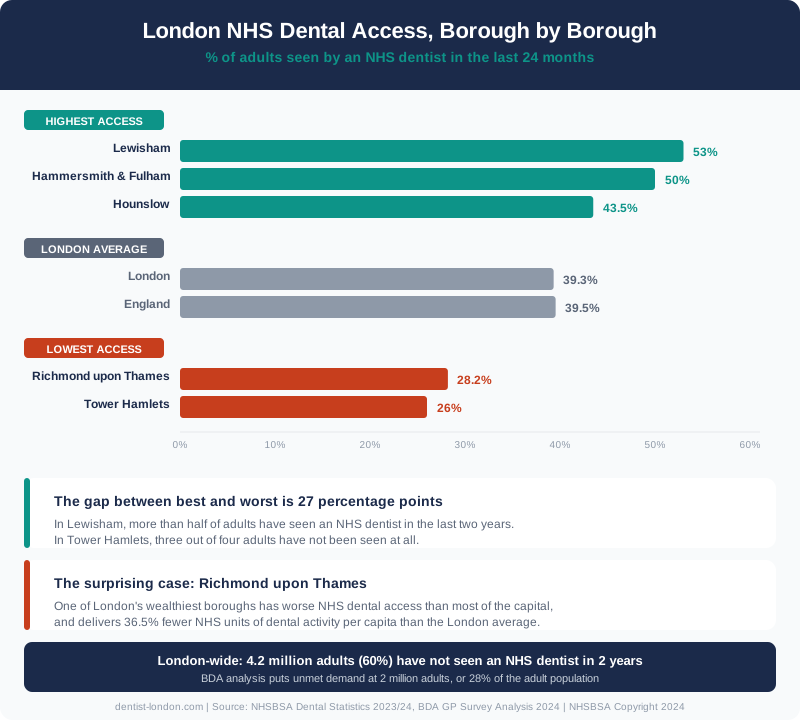
Using NHSBSA 2023/24 data on the percentage of adults seen by an NHS dentist in the previous 24 months and children seen in the previous 12 months, several boroughs stand out as having significantly better access than the London average of 39 per cent for adults and 53 per cent for children:
Lewisham: 53 per cent of adults seen in the last two years, the highest proportion of any London borough and well above both the London and national averages. Lewisham also has the lowest child tooth decay rate in London at 12 per cent.
Hammersmith and Fulham: around 50 per cent of adults seen. Notably, Hammersmith and Fulham also has the highest proportion of urgent NHS treatment in London at nearly 20 per cent, suggesting strong NHS contract commitment despite being a relatively affluent borough.
Hounslow: 43.5 per cent of adults seen and 61.4 per cent of children, one of the best child access rates in the capital. Hounslow delivers 22 per cent more NHS dental activity per capita than the London average.
Haringey: 68 per cent of children seen in the last 12 months, the highest child access rate in London and well above both the London average (53 per cent) and the national average (55 per cent).
The boroughs with the fewest NHS options
At the other end of the scale, several boroughs have adult access rates far below the London average, meaning the majority of residents are going years without seeing an NHS dentist:
Tower Hamlets: just 26 per cent of adults seen in the last two years. This is the lowest of any London borough (excluding the City of London) and is 13 percentage points below the London average. Despite this, Tower Hamlets Council runs one of London’s strongest school-based oral health programmes, applying fluoride varnish twice a year in every primary school.
Richmond upon Thames: 28 per cent of adults seen and just 46.5 per cent of children. Richmond delivers 36.5 per cent fewer NHS units of dental activity per capita than the London average. Healthwatch Richmond reports that finding an NHS dentist has been the single biggest patient access issue since 2020, with most practices quoting wait times of 12 to 24 months or not accepting new NHS patients at all.
Westminster: the lowest child access rate in London at around 30 per cent, meaning seven out of ten children are not being seen by an NHS dentist each year. Westminster also has the highest proportion of Band 3 (complex) treatment in the country at over 12 per cent, suggesting that when patients do reach an NHS dentist, they arrive with more advanced problems.
Hackney: only 32 to 38 per cent of children seen by an NHS dentist in the last 12 months, one of the lowest child access rates in the capital.
The surprising cases
Richmond upon Thames is the standout. It is one of London’s wealthiest boroughs, with high property values, good transport links, and no obvious characteristics of a dental desert. Yet its NHS dental access rate is worse than the majority of London boroughs, and dramatically worse than neighbouring Hounslow, which is just a few miles away but delivers 22 per cent more NHS activity per capita than the London average. The two boroughs share a border, but a Richmond resident looking for an NHS dentist faces a completely different reality to one in Hounslow.
London as a whole is a paradox. It has more dentists per capita than any other English region, the lowest vacancy rate, and the highest dental activity delivery rate (94.7 per cent of commissioned NHS activity was actually delivered in September 2024, compared to just 61.6 per cent in the South West). Yet the proportion of adults and children actually being seen is among the worst in the country. The dentists are there. They are delivering nearly everything the NHS commissions. The problem is that not enough is being commissioned in the first place.
The BDA’s analysis of GP Survey data puts the scale of the problem in concrete terms: unmet need for dentistry in London stands at approximately 2 million adults, or 28 per cent of the adult population. That includes 630,000 who tried and failed to get an appointment, and a further one million who have stopped trying because they believe appointments simply are not available.
What the April 2026 reforms change
The NHS dental contract reforms that took effect on 1 April 2026 should improve things at the urgent end. Every NHS contract holder now has a minimum quota of urgent care to deliver (8.2 per cent of contract value), and the payment for each urgent course of treatment has risen 76 per cent to £75. Walk-in urgent patients count towards that quota, so practices have a financial reason to keep the door open. Our emergency dentist London page lists practices currently offering urgent appointments.
But the reforms do not directly change the routine care picture. Practices still set their own policies on accepting new NHS patients for check-ups, hygienist visits, and ongoing care. If your local practice has a closed list, it stays closed unless the practice decides otherwise.
What patients can actually do
If you live in one of the harder boroughs, a few steps are worth taking:
- Search by area rather than borough. An east London postcode might have a practice in a neighbouring borough that is a shorter walk from your front door than the ones on your own borough’s list.
- Use our NHS filter, which flags practices currently accepting new patients based on the most recent verification.
- Widen your commute. A practice near your work may have very different availability from one near your home.
- For urgent problems, use NHS 111. Every NHS contract holder is now required to take a share of urgent patients in 2026/27. For Band 1 urgent care, the charge is £27.90.
- Consider dental schools. London has three major dental schools — King’s College, Barts/Queen Mary, and UCL Eastman — offering free NHS treatment from supervised students. The trade-off is longer appointments and possible waiting lists.
Methodology
This analysis draws on NHS Dental Statistics for England 2023/24 published by the NHSBSA (August 2024), with patients-seen data updated to June 2024. Borough-level figures for percentage of adults seen in 24 months and children seen in 12 months are taken from the NHSBSA geographical breakdown summary tables at local authority level.
London-wide statistics on unmet need are drawn from BDA analysis of the GP Patient Survey 2024, as submitted in written evidence to the London Assembly Health Committee in September 2024. Dentist headcount, vacancy rates, and activity delivery rates are from the NHS England Dental Workforce data collection (March 2024) and DHSC Dental Services monitoring data (September 2024).
Child tooth decay data is from the National Dental Epidemiology Programme (academic years 2021/22 and 2022/23). UDA per capita comparisons for individual boroughs are from Healthwatch Richmond’s analysis of NHSBSA data, presented in evidence to the London Assembly Health Committee. Practice-level NHS acceptance status on dentist-london.com is compiled from CQC data and NHS sources, supplemented with manual verification.
Frequently asked questions
Which London borough has the best NHS dental access?
Lewisham has the highest proportion of adults seen by an NHS dentist in the last two years at 53 per cent, based on NHSBSA data for 2023/24. For children, Haringey leads with 68 per cent seen in the last 12 months.
Which London borough has the worst NHS dental access?
Tower Hamlets has the lowest adult access rate at 26 per cent, excluding the City of London. For children, Westminster has the lowest rate at around 30 per cent.
Is London a dental desert?
Not as a whole. London has more dentists per square mile than any other part of England, the lowest vacancy rate nationally, and delivers nearly 95 per cent of its commissioned NHS activity. But several individual boroughs have NHS access levels that are worse than many rural areas traditionally thought of as dental deserts, because too little NHS care is being commissioned relative to demand.
Why can’t I find an NHS dentist even though there are practices nearby?
Most London practices are private-only or mixed, and the NHS portion of mixed practices is usually at capacity. A practice being nearby does not tell you whether it holds an NHS contract or whether it is currently accepting new NHS patients. Check the NHS status on each listing or use NHS 111 to find a practice with current capacity.
Sources: NHSBSA, NHS Dental Statistics for England 2023/24 (published August 2024, updated November 2024). BDA written evidence to the London Assembly Health Committee, September 2024. Healthwatch Richmond written evidence to the London Assembly Health Committee, September 2024. Commons Library, “How does access to NHS dentistry compare across areas in England?” (August 2025). NHS England, Dental Workforce data, March 2024. DHSC, Dental Services Activity Delivery Rate, September 2024. NDEP, Oral Health Survey of 5-Year-Old Children, 2021/22 and 2022/23. British Dental Journal, “Waiting in line for a check-up: evaluating access to NHS dental services in England” (May 2025). Data used under the Open Government Licence v3.0. NHSBSA Copyright 2024.
Data disclaimer: Borough-level access figures are from the latest available NHSBSA publication at time of writing. NHS acceptance status can change at short notice. Always verify directly with the practice.
Medical disclaimer: This page provides general information about dental access in London. It is not a substitute for advice from a qualified dentist. Always consult a qualified dentist about your individual circumstances.
Dentist-London.com updates borough access data as new NHSBSA publications become available. See our about page for methodology and data standards. Last reviewed April 2026.