



Published 6 March 2026
The NHS two-year rule catches out a surprising number of dental patients — often at the worst possible time. Understanding it now costs nothing. Being caught out by it when you actually need treatment can mean being turned away by the practice you have attended for years.
What the Two-Year Rule Actually Means
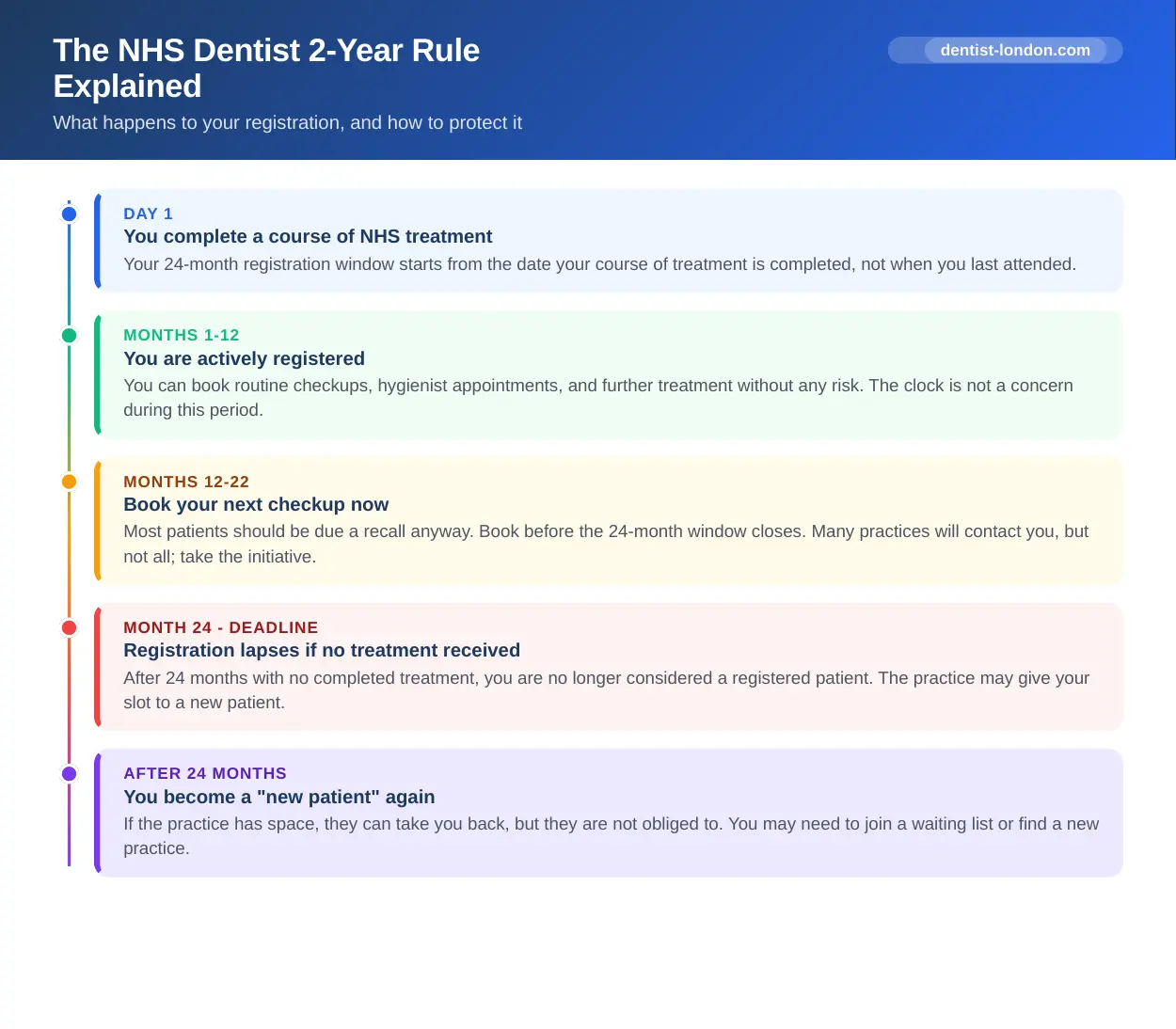
There is no formal registration system for NHS dentistry in England. Unlike GP practices, where you sign a form and are added to a named list, there is no official document linking you to a specific dental practice. Instead, you are considered an active patient at a practice for as long as you have attended within the past two years.
Once two years pass without a visit, your file is effectively lapsed. If you then try to book a routine appointment, the practice may treat you as a new patient — and if they are at NHS capacity, they may not be able to accommodate you on NHS terms at all. This is the practical consequence of the two-year rule, and it takes many people entirely by surprise.
Why It Matters in London Specifically
London has limited NHS dental capacity relative to its population in many boroughs. Practices in high-demand areas are consistently at or near the limit of their NHS contracts, and the distinction between an active patient and a lapsed one can determine whether you get an appointment or are turned away.
If your file has lapsed, a busy practice has no obligation to continue treating you under NHS terms. They may offer private appointments, or suggest you find a practice with NHS space for new patients. The particularly frustrating scenario is a patient who has attended the same practice for a decade, gone two years and a few months without a check-up, and then found themselves unable to access NHS treatment there. It happens.
What Counts as an Attendance
Any completed NHS dental appointment resets the clock — not just check-ups. A hygienist appointment, a filling, an X-ray review, an emergency appointment: any of these, if completed and recorded on your NHS record, keeps your status as an active patient.
What does not count: a missed appointment where you did not attend; an appointment rescheduled but not yet taken place; or an appointment you attended at a private practice rather than an NHS one. The relevant factor is whether clinical contact was made and recorded within the NHS system.
How to Protect Your NHS Patient Status
The Simplest Approach: Attend Regularly
If you attend for a check-up at least every 18 months, you will never get close to the two-year threshold. Most NHS dentists set recall intervals between 6 and 24 months based on clinical risk — following your dentist’s recommended interval keeps your file active and serves your dental health at the same time.
If You Have Already Gone Over Two Years
Contact your practice and explain the situation before assuming the worst. Many practices will accommodate long-standing patients with some flexibility, especially if your lapse was due to an unusual life circumstance — a period of illness, a house move, a demanding job change. There is no guarantee, but it is always worth the call.
If the practice cannot take you back on NHS terms, use our NHS dentist directory to find practices in your borough currently accepting new patients. It takes time, but finding a new NHS home is possible in most parts of London with some persistence.
Life Events That Create Risk
The most common reason for a two-year lapse is a significant life change: moving house, changing jobs, a period of illness or stress, or simply the relentless pace of London life making routine appointments easy to defer indefinitely. If you know you are entering a period where scheduling will be difficult, make a point of fitting in one check-up before the two-year mark, even if you do not feel you need one clinically.
Does the Rule Apply to Dental Emergencies?
No. If you are in dental pain, NHS 111 can direct you to an urgent dental care service regardless of your registration status. Emergency care sits outside the two-year rule entirely. However, urgent care services provide stabilisation and pain relief — not ongoing treatment. For continuing care after a dental emergency, being a registered patient at a practice remains important.
Private Dentists and the Two-Year Rule
The two-year rule applies only to NHS dentistry. Private practices have no equivalent concept. If you have not attended a private practice for five years and call to book, you will generally be welcomed back without any complications related to your registration history. This is one of the practical differences between NHS and private dental care that patients who have moved between the two sometimes find unexpected.
Key Points
- NHS dental registration lapses if you do not attend within two years
- Any completed NHS appointment — not just a check-up — resets the clock
- A lapsed file does not prevent you accessing emergency care via NHS 111
- Contact your practice before assuming you will be turned away — many are flexible
- Regular attendance is the simplest protection against losing your patient status
The two-year rule is particularly relevant if you are considering changing your NHS dentist or have recently moved to a new part of London.