



Published 24 February 2026
Changing your NHS dentist in London is a more straightforward process than most people expect — but finding a new one that is actually accepting patients is where the real challenge lies. Here is a clear, step-by-step guide to the full process.
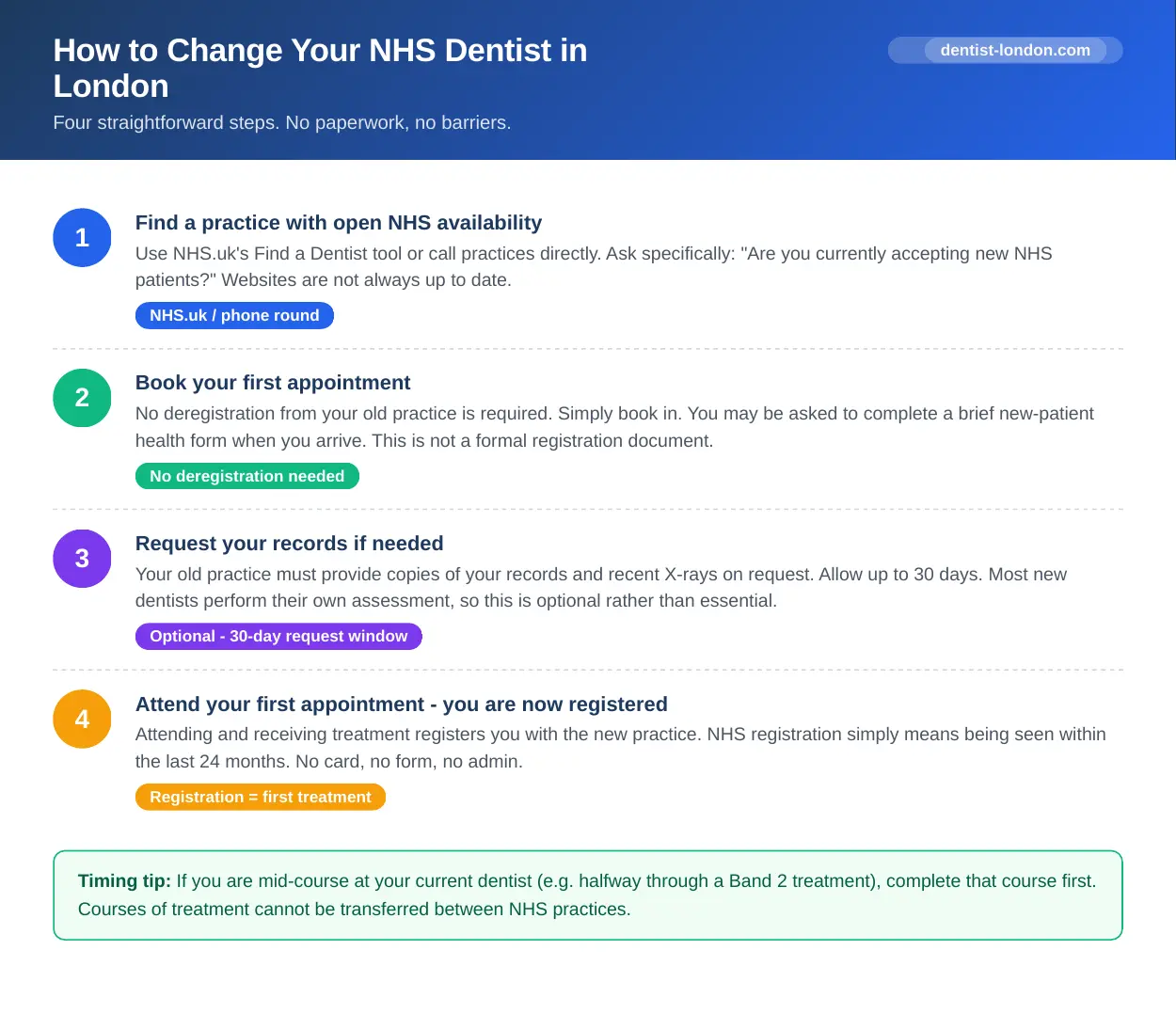
First: How NHS Dental Registration Actually Works
It is worth dispelling a common misconception before anything else. NHS dental registration is nothing like GP registration. There is no form to sign, no centralised patient list, and no official transfer process. You become an NHS patient at a practice by attending for treatment, and you remain one as long as you attend at least once every two years.
This means leaving your current NHS dentist requires no formal action. If you stop attending and begin going elsewhere, your registration at the old practice simply lapses over time. Many people spend months worrying about a deregistration process that does not exist.
Step One: Find Your New Practice First
The single most important thing to do before changing NHS dentist is to confirm that you have somewhere to go. Do not assume that finding an NHS dentist accepting new patients in London will be quick or easy.
London has a genuine shortage of NHS dental capacity in many areas. Practices that appear on NHS England’s online directory as “accepting new patients” may be full in practice — the directory is not always updated in real time. The only reliable way to confirm is to call directly.
What to Ask When You Call
- Are you currently accepting new NHS patients — not just for emergency appointments, but for routine ongoing care?
- How long is the current wait for a new patient appointment?
- Will I be able to book routine check-ups after my initial appointment?
If the first practice says no, try several more. Availability changes constantly as existing patients move, lapse, or transfer. Our NHS dentist directory is organised by borough and updated regularly — it is a faster starting point than the national tool.
Step Two: Book Your First Appointment
Once you have found a practice with availability, simply book a new patient appointment. You need no referral, no letter from your old practice, and no documentation of any kind. Just book and attend.
Your first appointment will typically include a full clinical examination, X-rays if they are clinically appropriate and you do not have recent ones, a charting of your existing dental status, and a discussion of any treatment they recommend along with what it will cost. This appointment is charged at NHS Band 1 (£26.80) unless treatment is carried out at the same sitting.
Step Three: Your Records
Your dental records belong to you and are held by your current practice. Once you are registered with a new practice, your new dentist can request them directly — this is a standard process and takes a few weeks. You can also request a copy yourself under your data subject access rights; the practice must provide it within one month, free of charge for an electronic copy.
In practice, most dentists prefer to carry out their own examination rather than rely entirely on records from elsewhere. The records are most useful for their X-ray history — a dentist who can see that you had a full-mouth series 18 months ago may not need to repeat all of them.
If You Are Mid-Course of Treatment
This is the one situation where timing genuinely matters. NHS treatment is charged by Band, not by individual procedure. If you have started a course of treatment — for example, one filling has been done but two more are planned — and you switch practices before the course is complete, your new dentist is likely to charge you from Band 1 again for continuing the work. This means paying twice for treatment that should have been one course.
Where possible, complete any started treatment at your current practice before switching. If that is not possible — because of a complaint, or because the practice has lost your trust — your new dentist may be able to continue the treatment and factor in what has already been done, but there are no guarantees.
A Note on Moving Borough
There is no geographical restriction on which NHS dentist you can attend. You can keep your dentist in one borough while living in another if you are willing to travel. In practice, for routine care, this is only sensible if the journey is manageable. If you have recently moved to a different part of London, our guide to what happens to your NHS dentist when you move borough covers the specific considerations in more detail.
Summary
- No paperwork is required to leave your current NHS dentist — registration lapses automatically
- Find and confirm your new practice before stopping attendance at your old one
- Call to confirm availability — do not rely on online directories alone
- Your first appointment at a new practice is charged at Band 1
- Complete ongoing treatment before switching if you possibly can
- Records can be requested by your new dentist once you have registered