



Published 15 February 2026
The idea behind dental insurance sounds sensible: pay a predictable monthly amount, and your dental costs are either covered or cushioned when treatment is needed. In practice, the maths does not always support it — and for many people in London, it represents a significant cost for limited benefit. Here is an honest look at whether dental insurance is worth taking out.
How Dental Insurance Works in the UK
UK dental insurance is not the same as private medical insurance. Rather than protecting you against catastrophic costs, it typically reimburses routine and some unexpected dental expenses up to an annual limit. Most policies work on a reimbursement basis: you pay for treatment, submit a claim with your receipt, and receive a payment back — usually within a few weeks. A smaller number of policies work directly with partner practices, meaning you pay nothing upfront for covered treatments.
Cover is usually tiered: 100% reimbursement for preventive care such as check-ups and hygienist appointments, 80% for basic treatment such as fillings and extractions, and around 50% for major work such as crowns and root canals — all subject to annual limits that vary by policy.
What Is Typically Covered — and What Is Not
What Standard Policies Usually Include
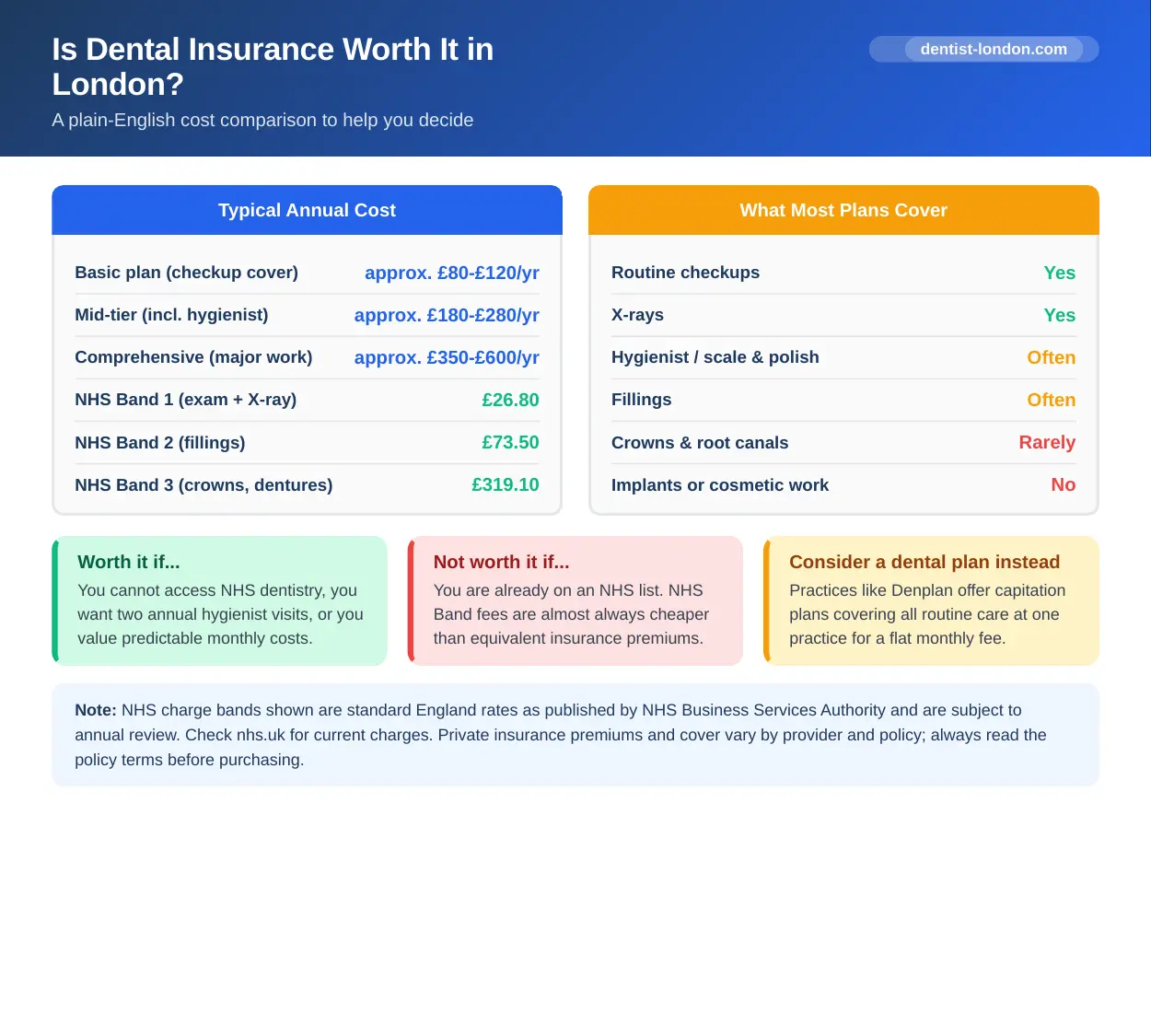
Routine check-ups (typically two per year), X-rays taken during check-ups, scale and polish appointments, fillings, extractions, root canal treatment, and emergency dental care abroad are the core of most policies. Some also include limited orthodontic cover or offer it as an optional add-on.
What Is Almost Always Excluded
Cosmetic treatments — teeth whitening, veneers, composite bonding, cosmetic Invisalign — are excluded by virtually all standard dental insurance policies. Pre-existing conditions are routinely excluded for the first 12 months and sometimes permanently. Dental implants are rarely covered, and when they are, the limits are typically too low to be meaningful given their actual cost.
Running the Numbers
A mid-range dental insurance policy typically costs £8 to £15 per month — between £96 and £180 per year. Compare that to what you would actually pay without insurance:
- NHS check-up (Band 1): £26.80
- Two NHS check-ups per year: £53.60
- NHS filling (Band 2): £73.50
If you are an NHS patient who attends two check-ups a year and needs an occasional filling, your annual NHS spend might be £53.60 to £127.10. Even a budget insurance policy at £96 a year costs you more. The numbers only start to shift in your favour if you are a private patient who attends regularly and needs treatment beyond check-ups.
Private dental costs in London are substantially higher: a check-up at £90, two hygienist appointments at £80 each, and one filling at £220 adds up to £470 in a year. At that level, a policy reimbursing £550 to £600 annually starts to make financial sense — provided the treatment you actually have falls within what is covered.
Alternatives Worth Considering
NHS Treatment
If you can access an NHS dentist, the cost of routine care is low enough that insurance adds little value. The challenge in London is finding a practice with NHS appointments available — but if you are on an NHS list, that is your most cost-effective option for standard care.
Dental Payment Plans
Plans such as Denplan are not insurance. They are a direct payment arrangement with your own practice, covering your routine care in exchange for a monthly fee. For regular attenders, these often deliver better value than insurance because there are no reimbursement delays, no claim forms, and the cost is specific to your dental health rather than based on a broad population average. Our guide to Denplan versus pay-as-you-go covers this in detail.
A Dedicated Savings Pot
Some people prefer to transfer the equivalent of a monthly premium into a dedicated savings account for dental costs. This gives complete flexibility — you can use it for any treatment, including cosmetic work — without exclusions, waiting periods, or claim processes. Over time, for people with good dental health, the savings accumulate rather than being consumed by premiums.
When Insurance Makes the Most Sense
Dental insurance is most likely to be worth it if: you want private treatment but are sensitive to unpredictable costs; you have a history of needing significant dental work; you travel frequently and want emergency dental cover abroad included; or the predictability of a fixed monthly outgoing is genuinely important to how you manage your finances.
It is least likely to be worth it if: you have access to NHS dental care; you have excellent dental health and rarely need more than a check-up; or you are hoping it will cover cosmetic procedures — it will not.
The Bottom Line
For most NHS dental patients in London, dental insurance is hard to justify on pure financial grounds. For private patients who attend regularly and need occasional treatment, a well-chosen policy can represent reasonable value — but the details matter enormously. Read the exclusions, check the annual limits, and compare the reimbursement rates against what your specific practice actually charges before signing up.