



Published 17 March 2026
Moving to a new part of London raises all sorts of practical questions. What to do about your NHS dentist is one that catches people off guard — usually because the system works very differently from how most people assume it does.
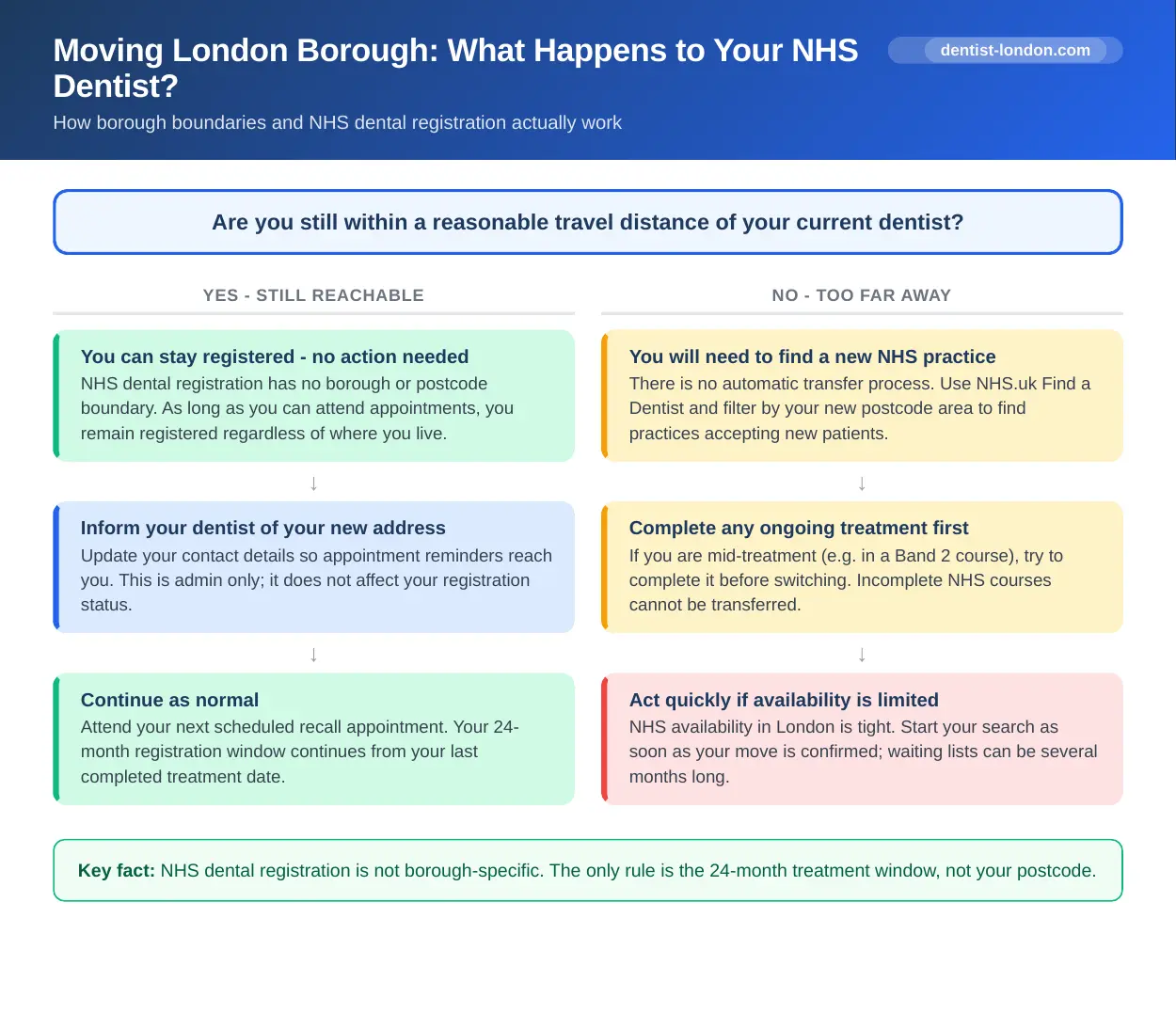
There Is No Automatic Transfer
NHS dental registration does not transfer when you move house. Unlike your GP, where moving address typically prompts re-registration with a local practice and your records follow you through a central system, dental care has no equivalent mechanism.
If you move from Islington to Lewisham, your old Islington dentist does not send your records to a Lewisham practice. No system alerts a new practice that you exist. You remain, technically, an active NHS patient at your old practice — for as long as you attended within the past two years — but nothing happens automatically to establish your dental care in your new borough.
Can You Keep Your Old Dentist?
Yes, in principle. There is no geographical restriction on which NHS dentist you can attend. If you were happy with your dentist in Barnet and have moved to Croydon, you can continue attending there if you are willing to travel.
In practice, this works for planned routine appointments but becomes impractical for urgent care — commuting across London when you have toothache is not a realistic option. Most people who move borough do eventually register locally. The question is how quickly to start that process and how to go about it.
Finding an NHS Dentist in Your New Borough
Start Your Search Early
If you are planning a move, start looking for a new NHS dentist before you move rather than after. Finding a practice with genuine NHS availability in London can take weeks or months in areas with high demand. Our directory of NHS dentists in London is organised by borough and updated regularly — it is a faster way to narrow down options than the national NHS tool, which can be slow to reflect current availability.
Call to Confirm Before You Arrive
Online directories showing a practice as “accepting new patients” are not always current. The only reliable way to confirm availability is to call the practice directly and ask: are you accepting new NHS patients for ongoing routine care? How long is the current wait for a new patient appointment?
Do not assume availability until you have spoken to someone who can actually book you in.
Cast a Wider Net
There is no requirement to register with the nearest practice to your new home. If the practices immediately local to you are full, look at neighbouring areas. A 15-minute bus ride to a practice with genuine NHS availability is a better outcome than months on a waiting list for a practice around the corner.
Transferring Your Records
Your dental records belong to you and are held by your old practice. Once you register with a new practice, your new dentist can request them directly — this is entirely standard and takes a few weeks. You can also request them yourself under your data access rights; the practice must provide an electronic copy within one month, free of charge.
In practice, most dentists carry out their own clinical examination at a first appointment rather than relying on records from elsewhere. Records are most useful for their X-ray history — if you have had recent full-mouth X-rays, there is no clinical reason to repeat them, and a new dentist who can see these will avoid unnecessary radiation exposure.
Borough-Specific Challenges
Not all London boroughs are equally well served by NHS dental provision. Some areas — particularly parts of inner east and south-east London — have significantly lower NHS dental capacity relative to their population. If you are moving to one of these areas, expect the search for a new NHS dentist to take longer.
If you genuinely cannot find a practice accepting new patients despite persistent searching, contact NHS England’s patient services. They can sometimes identify practices with capacity that are not widely advertised.
If You Cannot Find an NHS Practice Immediately
If you are still searching and need to maintain your dental health in the interim, consider a private check-up at a practice you can access. It will cost more than NHS treatment — a private check-up in London is typically £70 to £130 — but it is better than leaving your dental health unattended while you wait for NHS availability.
For guidance on how the switching process works more generally, our article on how to change your NHS dentist covers the step-by-step process in detail.
Key Takeaways
- Moving borough triggers no automatic transfer of your dental records or registration
- You can keep your old dentist if you are willing to travel — there is no geographical restriction
- Start searching for a new practice before you move, not after
- Call practices to confirm availability — online listings are not always current
- Your records can be requested by your new dentist once you have registered
- Availability varies significantly by borough — be prepared to search more widely than your immediate postcode