



Published 19 February 2026
Most people stay with the same dentist longer than they should — not because they are satisfied, but because they assume switching is complicated. It is not. Moving to a new dental practice is simpler than most people expect, and in most cases, you do not even need to inform your old dentist you are leaving.
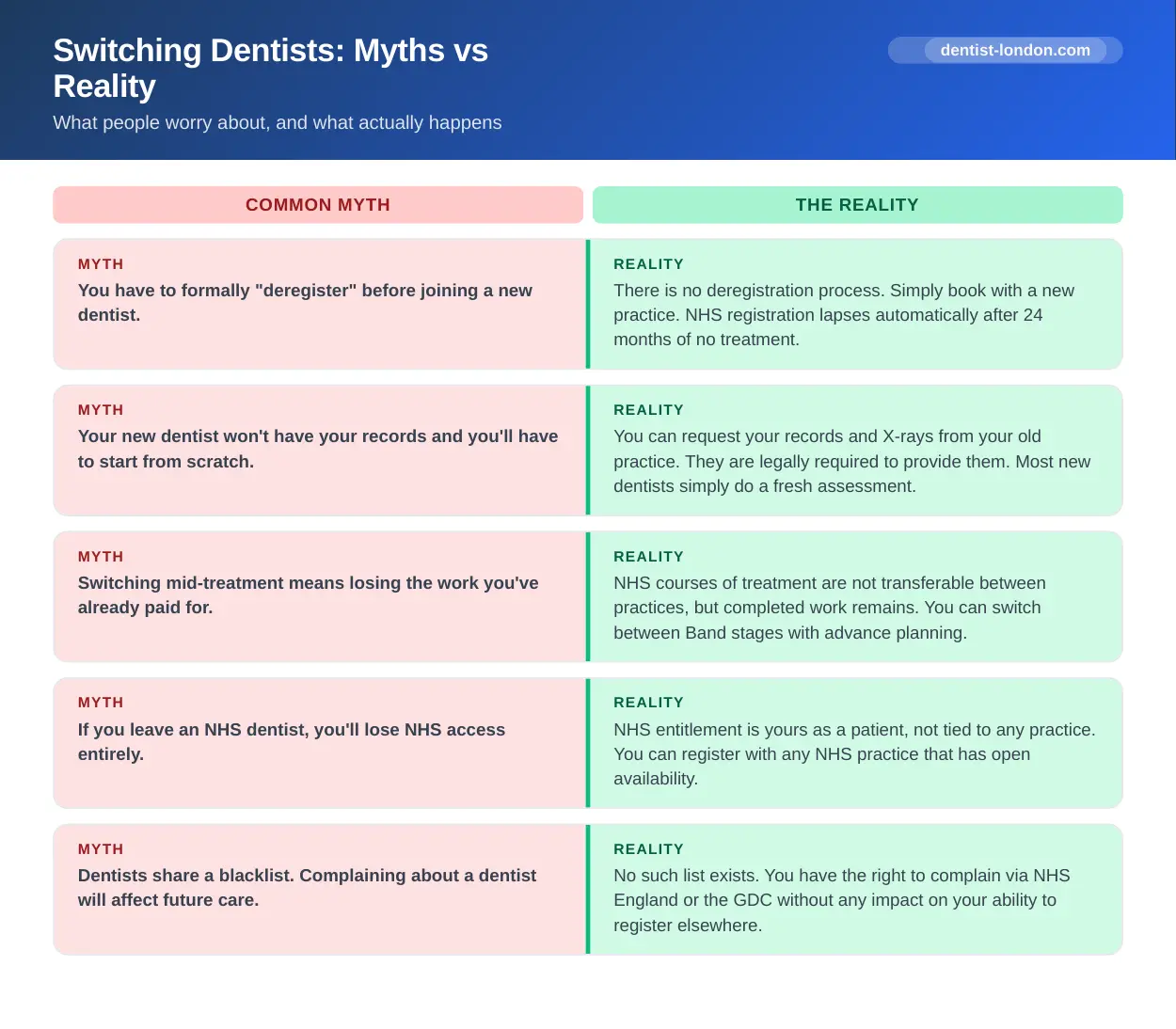
There Is No Formal Deregistration Process
Unlike leaving a GP practice — where you complete a form and are removed from the list — leaving an NHS dental practice requires nothing formal whatsoever. NHS dental “registration” simply means you have attended within the past two years. Once two years pass without a visit, your file lapses automatically. Before that point, if you stop attending and register elsewhere, your old practice will eventually close your file without any action required on your part.
You do not need to write a letter, call to cancel, or explain your reasons for leaving. You can simply book with a new dentist and attend. The process is completely patient-led.
What Happens to Your Records
Your dental records are held by the practice, not by NHS England or any central body. They belong to you, and you have the right to access them under UK data protection law.
If you want records transferred to a new practice, there are two straightforward routes. Your new dentist can request them directly from your old practice — this is standard and takes a few weeks. Alternatively, you can submit a subject access request directly to your old practice and receive a copy within one month, free of charge for digital records.
In practice, most dentists carry out their own full examination at a new patient appointment, so records are useful background rather than an urgent requirement. The one exception is recent X-rays — if you have had X-rays in the past 12 to 18 months, transferring them can avoid the need for repeat radiation exposure at your new practice.
NHS Switching: Three Things to Know
Find Your New Practice Before You Leave
This is the most important piece of advice. Confirm that you have somewhere to go — and that they are genuinely accepting new NHS patients — before you stop attending your current practice. In London, NHS dental capacity is limited in many boroughs, and finding a practice with availability can take time. Use our NHS dentist directory to check current availability, and always call to confirm rather than relying on online listings alone.
Timing Around Treatment in Progress
If you are mid-way through a course of NHS treatment — for example, you have had one of three planned fillings — switching at that point can create complications. NHS treatment is charged by Band, not by individual procedures, and starting a new course of treatment at a new practice may mean being charged again from Band 1. Where possible, complete any ongoing treatment before making the switch.
Waiting Times at New Practices
Registering with a new NHS dentist does not mean you will be seen immediately. Some practices have waiting times of several months for new patient appointments. Plan ahead rather than switching at the point when you already need urgent treatment — that is a stressful combination.
Private Switching: Even Simpler
Leaving a private practice is more straightforward still, because there is no registration concept in private dentistry. You are simply a patient who attended. Stop booking there, start booking somewhere else. If you have outstanding treatment planned, the only practical consideration is whether you want to complete it at the same practice for continuity, or start fresh elsewhere.
Private practices compete for patients more actively than NHS practices, and many will make efforts to retain you if they know you are considering leaving — including addressing concerns you have raised. You are under no obligation to stay, but if there is a specific issue driving the switch, it is worth raising it directly first.
What Your First Appointment at a New Practice Involves
A new patient appointment at any dental practice — NHS or private — will typically include a full clinical examination, X-rays if you have not had recent ones and they are clinically appropriate, a charting of your current dental status (a record of all your teeth and existing work), and a discussion of any treatment recommended.
This appointment is about establishing a baseline. Your new dentist is not there to judge your previous care — they are gathering the information they need to provide good ongoing treatment. Bring any details you can recall: the name of your previous practice, an approximate date of your last appointment, and any treatment that was recommended but not yet completed.
A Note on Red Flags
If a new dentist immediately proposes significant treatment at a first appointment without a thorough explanation of the clinical reasoning, be cautious. A new patient examination should result in a clear conversation about options, not a rushed treatment plan. If anything feels disproportionate or unexplained, a second opinion is entirely reasonable — any reputable dentist will understand and support that decision.
Switching dentists is a routine part of life for most people. If you are unhappy with your current care, have moved to a different part of London, or simply want to try somewhere new, you have every right to do so. Our directory of London dentists can help you find a practice that suits you.