



Published 12 February 2026
Choosing a dentist should not be complicated. But with hundreds of practices across London and no shortage of conflicting online reviews, it can feel like a decision made with incomplete information. Here is a practical guide to finding a practice you will actually want to keep going back to.
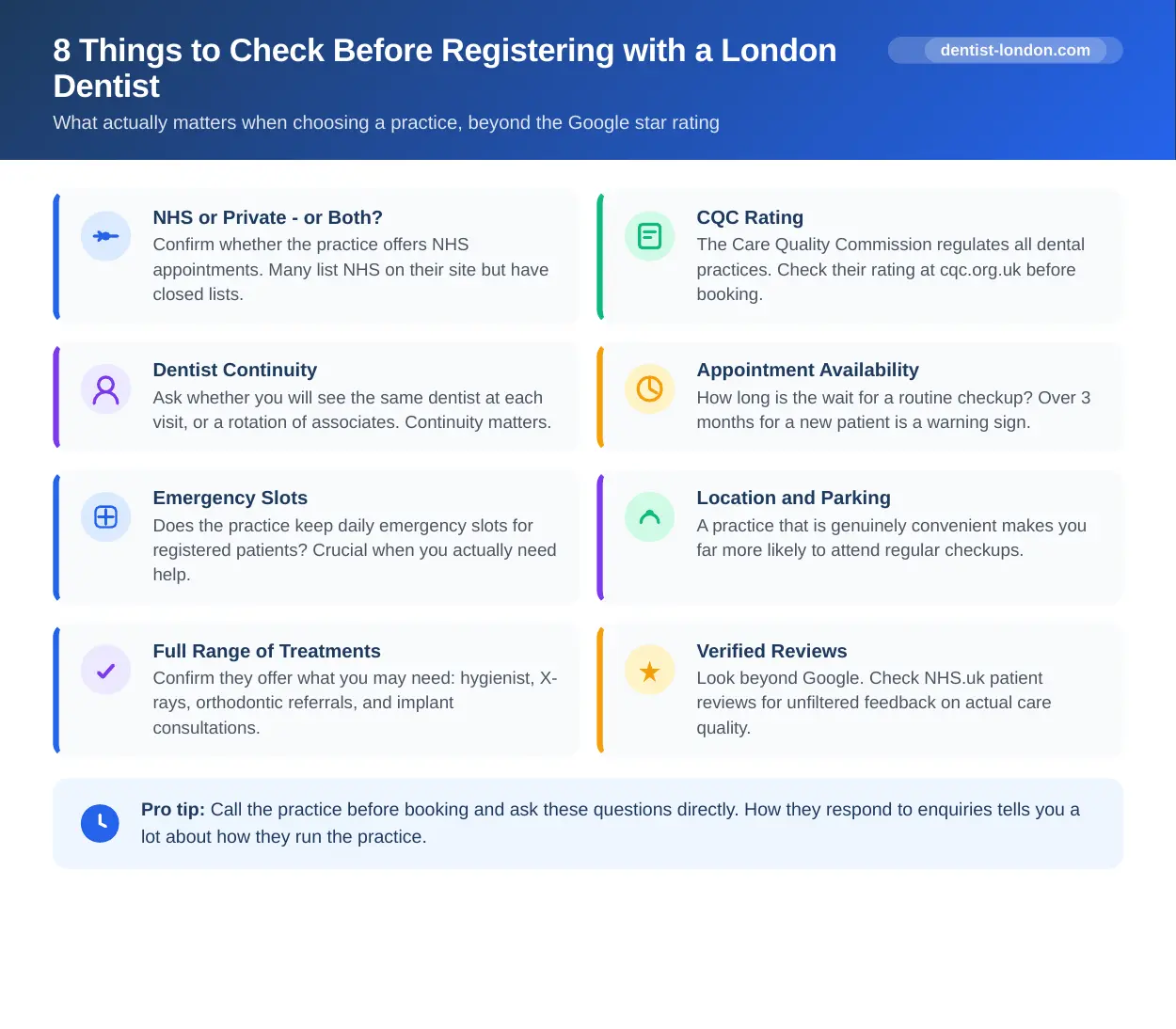
NHS or Private — Settle This First
The most important initial decision is whether you are looking for NHS or private treatment. NHS care is subsidised: even the most complex treatment is capped at £319.10 per course. The trade-off is availability — NHS dentists in London often have waiting lists, and routine check-up appointments may be less frequent than you would get privately.
Private dentistry offers more flexibility. Appointments tend to be longer, you can usually book sooner, and practices offer a wider range of treatments including cosmetic work. The obvious trade-off is cost: a private check-up alone in London typically runs £70 to £130, with treatment charged separately on top.
Neither is inherently superior. The right choice depends on your dental health, your budget, and whether you can actually access an NHS dentist in your area. In parts of London, that second point is not a given.
What to Look For Beyond the Star Rating
CQC Registration and Rating
All dental practices in England must be registered with the Care Quality Commission. The CQC inspects practices against five standards — safe, effective, caring, responsive, and well-led — and publishes its findings publicly. You can check any practice at cqc.org.uk. A “Good” or “Outstanding” rating is a meaningful signal; a “Requires Improvement” rating warrants investigation of the specific areas flagged.
Reading Online Reviews Properly
Reviews are useful but require interpretation. Look for patterns across a large sample rather than fixating on individual comments. A practice with a 4.5 rating from 350 reviews tells you more than one with a 5.0 rating from 14. Pay particular attention to how the practice responds to critical reviews — a considered, professional response to a complaint reveals more about the culture than five glowing testimonials.
Also check the recency of reviews. A cluster of negative reviews from two years ago may reflect a dentist who has since left. Consistent recent feedback is more predictive of what your experience will actually be.
Continuity of Care
An underrated factor is whether you are likely to see the same dentist each visit. At larger corporate practices, staff turnover can be high, and you may see a different clinician at every appointment. Continuity matters: a dentist who has seen you regularly builds genuine knowledge of your oral health over time — your anxiety levels, your tendency towards gum inflammation, the filling that is starting to show wear. Ask when booking how appointments are allocated.
Practical Considerations
Location and Convenience
A dentist you will not attend is not a good dentist, regardless of clinical skill. A practice near your workplace or on your commute route is more likely to result in you actually keeping routine appointments. Check public transport links, parking availability, and — if relevant — wheelchair access and step-free entry before committing.
Opening Hours
Many working Londoners cannot easily attend weekday morning appointments. Check whether the practice offers early, late, or weekend slots. These are more common at private practices but some NHS providers have adapted their hours. A practice that is theoretically convenient but only open during hours you cannot use is not actually convenient.
How the Practice Communicates
Notice how the practice handles your initial enquiry. Are they helpful on the phone? Do they answer questions clearly rather than deflecting? Do they tell you the likely wait for an appointment rather than leaving you to guess? How a practice treats a potential new patient tells you a great deal about how it will treat you as an ongoing one.
Your First Appointment
Use your initial appointment to assess the practice as much as to have your teeth checked. A thorough first examination should include assessment of your teeth, gums, and soft tissues — including a brief visual check for signs of oral cancer — plus X-rays if clinically appropriate and a clear discussion of any treatment recommended and its cost, before you agree to book anything.
If you leave without knowing what was found, what treatment (if any) is recommended, and what it will cost, that is a problem. Good dental practice means informed patients, not patients who simply turn up and do what they are told.
Questions to Ask Before You Book
- Are you currently accepting new NHS / private patients?
- How long is the current wait for a new patient appointment?
- Will I typically see the same dentist at each visit?
- What happens if I have a dental emergency between appointments?
- Can you give me a written estimate before starting any treatment?
Asking these questions before you commit will save you time and frustration. Finding a dentist you trust — and who you will actually attend regularly — is one of the most practical things you can do for your long-term health. Browse our London dentist directory to compare practices near you.