



Published 27 March 2026
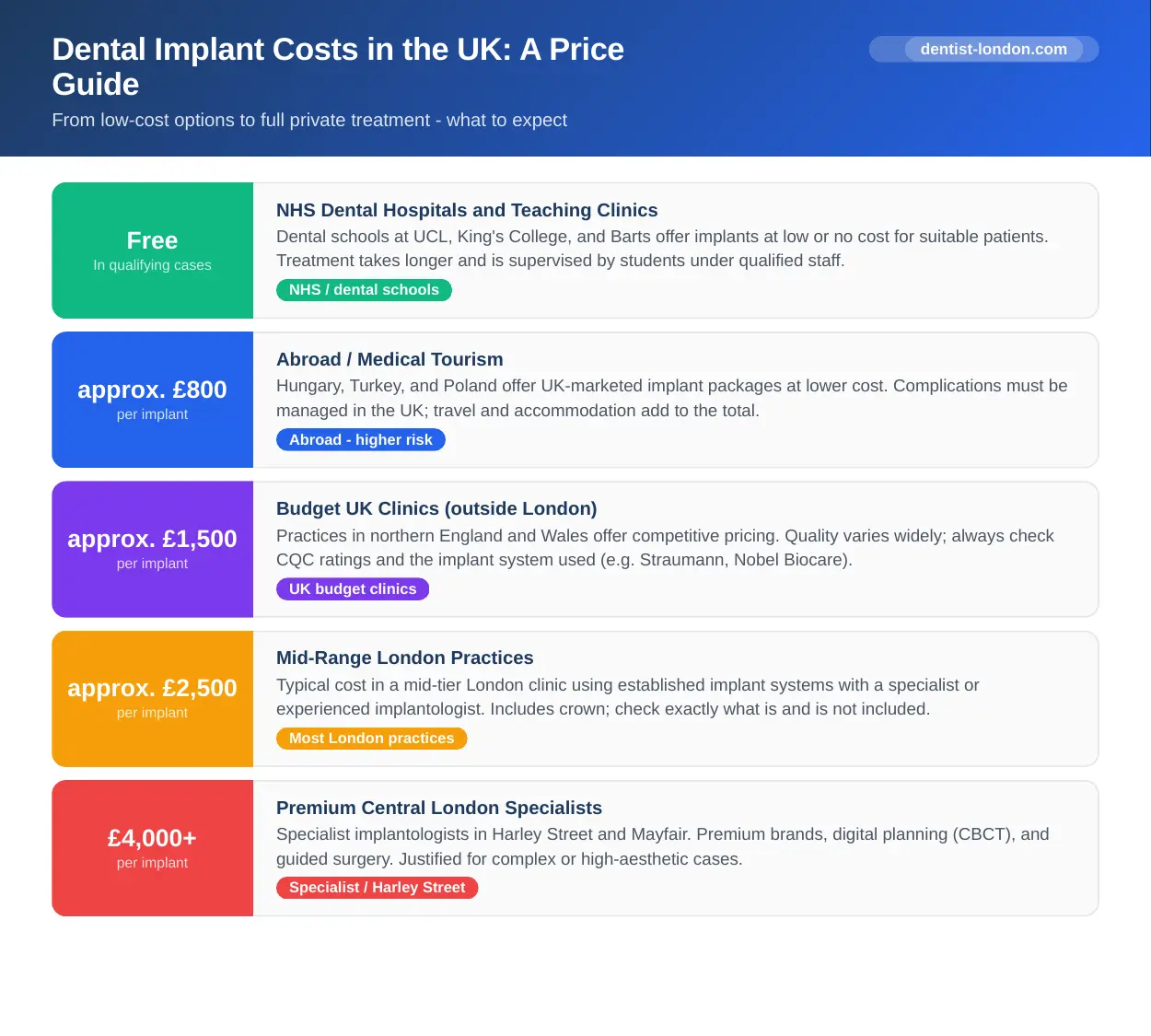
Dental implants are the gold standard for replacing missing teeth, and they are expensive. A single implant in London typically costs between £2,000 and £3,500, which puts them out of reach for a great many patients who need them. But there are genuine, legitimate routes to implant treatment at significantly lower cost — and in some cases, at no cost at all — if you know where to look and are prepared for what each route involves.
Why Dental Implants Are So Expensive
The cost of a dental implant reflects multiple components: the titanium implant fixture itself, the surgical placement procedure, the abutment that connects implant to crown, the final crown, and the significant training, equipment, and facility costs involved in providing implant surgery safely. Each stage requires a specifically trained and qualified clinician.
NHS implants exist in principle — the NHS can fund implants in specific clinical circumstances — but in practice they are extremely rare. NHS funding is generally limited to patients who have lost teeth as a result of cancer treatment, certain accidents, or specific genetic conditions such as severe hypodontia. For the overwhelming majority of patients who simply have a missing tooth following extraction, implants are a private treatment.
Dental Schools: The Most Reliable Route to Lower-Cost Implants
University dental schools train the next generation of dental specialists, and they need patients on whom their students can develop clinical skills. Treatment at a dental school is carried out by students — typically final-year postgraduate students specialising in implantology — under the close supervision of experienced, qualified clinicians who are present throughout.
The quality of treatment is generally excellent. The trade-off is time rather than quality: procedures take longer because the supervisor checks and guides at each stage, and the overall treatment journey from assessment to final crown is typically slower than at a private practice. Waiting times to begin treatment are also longer.
London Dental Schools Offering Implant Treatment
- King’s College London Dental Institute at Denmark Hill — one of the largest dental schools in Europe, offering implant treatment through its specialist postgraduate programmes
- UCL Eastman Dental Institute in Bloomsbury — offers implant treatment as part of its postgraduate specialist training
- Barts and The London School of Medicine and Dentistry — provides access to training-supervised clinical treatment
- Guy’s Hospital Dental School — a long-established training facility offering a range of specialist treatments
Costs vary by school and case complexity but are typically 40 to 70 percent lower than standard private rates. Contact each school directly to ask about current waiting times and the process for becoming a treatment patient.
Clinical Trials and Research Studies
Implant research is ongoing, and clinical trials periodically need patient participants. If you meet the eligibility criteria for a study, you may receive implant treatment at no cost — or at significantly reduced cost — in exchange for consenting to assessments and data collection over a follow-up period.
Relevant places to search for current dental implant trials in the UK:
- The NIHR Clinical Research Network at nihr.ac.uk
- The Be Part of Research website at bepartofresearch.nihr.ac.uk
- Individual dental school research departments directly
Eligibility criteria vary by study and can be specific. Not all trials will be relevant to your situation, and not all will be recruiting in London at any given time. But if you are in a relevant age group or have a clinical presentation that matches a study’s needs, this is a genuine option worth exploring.
Finance and Payment Plans
If you are paying standard or near-standard private rates, spreading the cost through a finance arrangement can make implants accessible without waiting. Most practices offering implants work with third-party finance providers, offering 0% or low-interest options typically over 12 to 24 months. This converts a £2,500 upfront cost into monthly payments of around £100 to £210, which is manageable for many people who could not pay the lump sum.
When getting quotes, always ask for the total cost covering all stages — assessment, implant placement, healing period appointments, abutment, and final crown. Some practices advertise an implant price that covers only the fixture itself, making comparison between practices misleading.
What to Be Wary Of
Very Low-Cost Implants
Implants advertised at £699 or £895 are almost always either loss leaders with significant additional costs, or they use implant components from lower-grade manufacturers. Implant longevity is significantly affected by component quality — cheaper components have meaningfully higher failure rates over a 10 to 15-year horizon. A failed implant can be more costly and more complex to resolve than the original extraction was.
Dental Tourism
Some patients travel to Hungary, Poland, or Turkey for implant treatment, where costs can be 40 to 60 percent lower than London private rates. At reputable clinics, the clinical quality can be good. The risk lies in managing complications — which can emerge months or years after placement — when the treating practice is overseas. If you consider this route, use clinics with established English-language aftercare, and confirm that a UK dentist is willing to provide any follow-up support if needed.
Is There Any Other NHS Route?
Beyond the specific clinical cases mentioned above, NHS implant funding can occasionally be accessed via referral from your NHS dentist to a hospital maxillofacial or specialist restorative department. This requires your dentist to make a clinical case that implants are the clinically appropriate treatment and that alternatives are unsuitable. It is uncommon, but worth discussing with your dentist if your situation is complex.
A Realistic Summary
- Standard implant costs in London are £2,000 to £3,500 per tooth, all stages included
- Dental schools offer the most reliable route to substantially lower costs — expect 40 to 70% less, but longer timescales
- Clinical trials occasionally offer treatment at no cost in exchange for participating in research
- Finance options spread cost without reducing it — always get a total-cost quote
- Avoid implants priced dramatically below the market — component quality affects long-term outcomes
If you are exploring your options, our London dentist directory includes practices offering implant consultations where you can get a detailed assessment and comparable quotes.
For a wider look at affordable dental care options in London — including dental schools, payment plans, and NHS exemptions — see our guide to affordable dental care in London.
Some patients also consider dental tourism to Turkey as a route to lower-cost implants. Our article on why dental implants are so cheap in Turkey gives an honest assessment of the risks and when the approach can work — worth reading before making any decisions about travelling abroad for treatment.