



Published 13 March 2026
Walk down most London high streets and you will find practices from recognisable dental brands alongside independent surgeries that have been run by the same family for decades. Does the ownership structure of a practice actually matter for the quality of care you receive? The answer is more nuanced than most people expect.
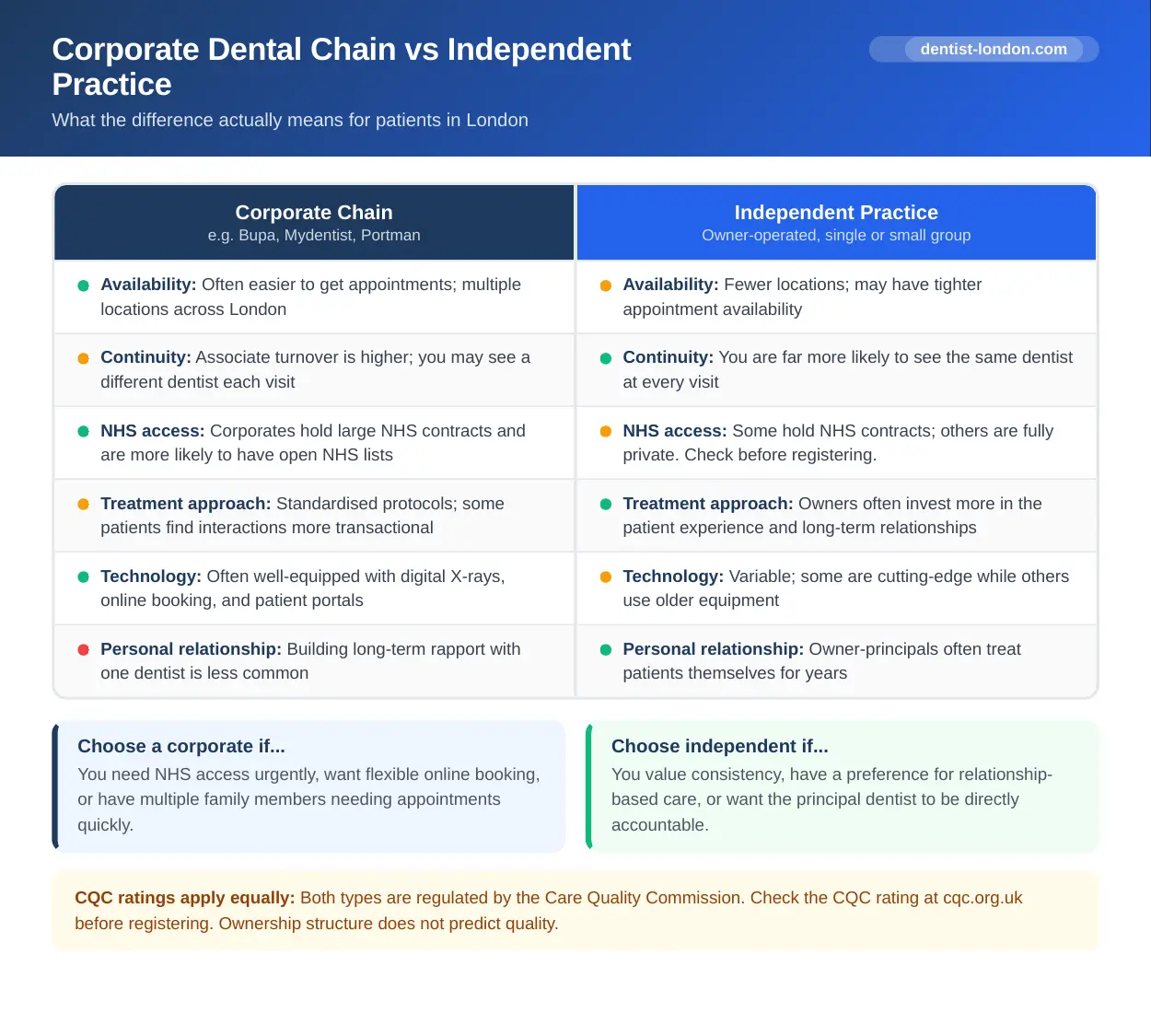
The Rise of Corporate Dentistry in London
Dental consolidation in the UK has accelerated considerably over the past 15 years. Corporate groups now own around a third of all dental practices in England, with the proportion higher in London where acquisition targets are concentrated. The major groups — including Bupa Dental Care, Portman Dental Care, and MyDentist — each operate dozens of London locations.
This consolidation is not inherently a problem. Corporate ownership does not automatically mean lower quality care. But it does mean different management structures, different incentives, and — in many cases — a noticeably different patient experience.
The Case for Corporate Practices
Convenience and Booking
Large groups invest significantly in booking infrastructure. Online appointment systems, app-based management, extended opening hours, and multiple locations mean you can often book more easily and more flexibly than at a smaller practice. For busy Londoners who struggle to find appointment times that fit around work, this is a meaningful practical advantage.
Equipment and Environment
Corporate practices tend to have newer equipment — digital X-rays, intraoral cameras, and cosmetic treatment technology — because they have the capital to invest across their estate in a way that a small independent practice may not. You are also more likely to encounter a recently refurbished clinical environment.
Standardised Systems
Large groups have dedicated compliance teams and standardised procedures. In principle, this reduces variability in how the practice operates — you can expect broadly consistent standards of record-keeping, infection control, and patient communication regardless of which branch you attend.
The Case for Independent Practices
Continuity of Care
This is perhaps the strongest argument for independent practices, and it is one that patient reviews consistently confirm. When the same dentist sees you year after year, they build genuine, detailed knowledge of your dental history — your anxiety levels, your tendency towards plaque build-up, the crown that has been showing slight wear for the past two years. That accumulated context matters clinically.
At many corporate practices, staff turnover is higher, and you may see a different clinician at each appointment. This is not universal — some corporate practice managers make continuity a specific priority — but it is a structural tendency worth asking about before you commit to registering.
Clinical Autonomy
Independent dentists own their clinical decisions without external constraints. Dentists employed by corporate groups work within protocols, target frameworks, and sometimes referral restrictions that can — in some cases — affect which treatment options are presented to patients. An independent practitioner’s recommendation is more straightforwardly based on their clinical judgement.
Relationship and Responsiveness
Smaller practices often invest more in patient relationships. You are more likely to be remembered by name, to receive a call if your appointment is running late, and to feel genuinely known as a patient rather than a booking reference. This matters most for anxious patients, where familiarity and a personal relationship can significantly reduce the difficulty of attending.
When things go wrong — and occasionally they do in any practice — independent practices where the owner is also the clinician tend to respond faster and more directly. Their professional reputation is personally at stake in a way that differs from a regional manager reviewing a complaint form.
Is There a Genuine Quality Difference?
Clinically, the evidence does not favour one model decisively. Both types of practice are regulated by the CQC and must meet the same standards. The skill of the individual dentist matters far more than who signs the payroll. Poor dentistry exists in independent practices; excellent dentistry exists in corporate ones, and vice versa.
Where consistent differences emerge is in the softer elements of care: how quickly concerns are addressed, how thoroughly options are explained before treatment, how patients are treated when something is not right. These factors matter for patient experience even when clinical outcomes are equivalent.
NHS Access in Both Settings
Both corporate groups and independent practices offer NHS and private treatment, though the mix varies. One trend worth noting: several corporate groups have reduced or exited NHS contracts in recent years, citing low NHS contract values relative to the cost of delivery. If NHS access is important to you, confirm specifically that the practice you are considering offers NHS appointments at the volume you need — do not assume it based on the group’s general reputation.
How to Choose
Rather than choosing based on corporate or independent ownership, choose based on the specifics of the individual practice:
- Check the CQC rating for that specific location, not just the brand overall
- Read recent reviews — within the past 12 months — for that particular practice
- Ask how long the current dentists have been at the practice
- Ask directly about continuity of care before booking
- Confirm NHS availability if that matters to you
Corporate or independent, what matters most is finding a dentist you trust and a practice you will actually attend. Browse our London dentist directory to compare practices across the city.