



Published 3 March 2026
Both Invisalign and fixed braces can straighten your teeth effectively. The decision between them is less about which is objectively better — it is about which is right for your specific clinical situation, your lifestyle, and your realistic budget. Here is a practical comparison to help you make a clear-eyed decision.
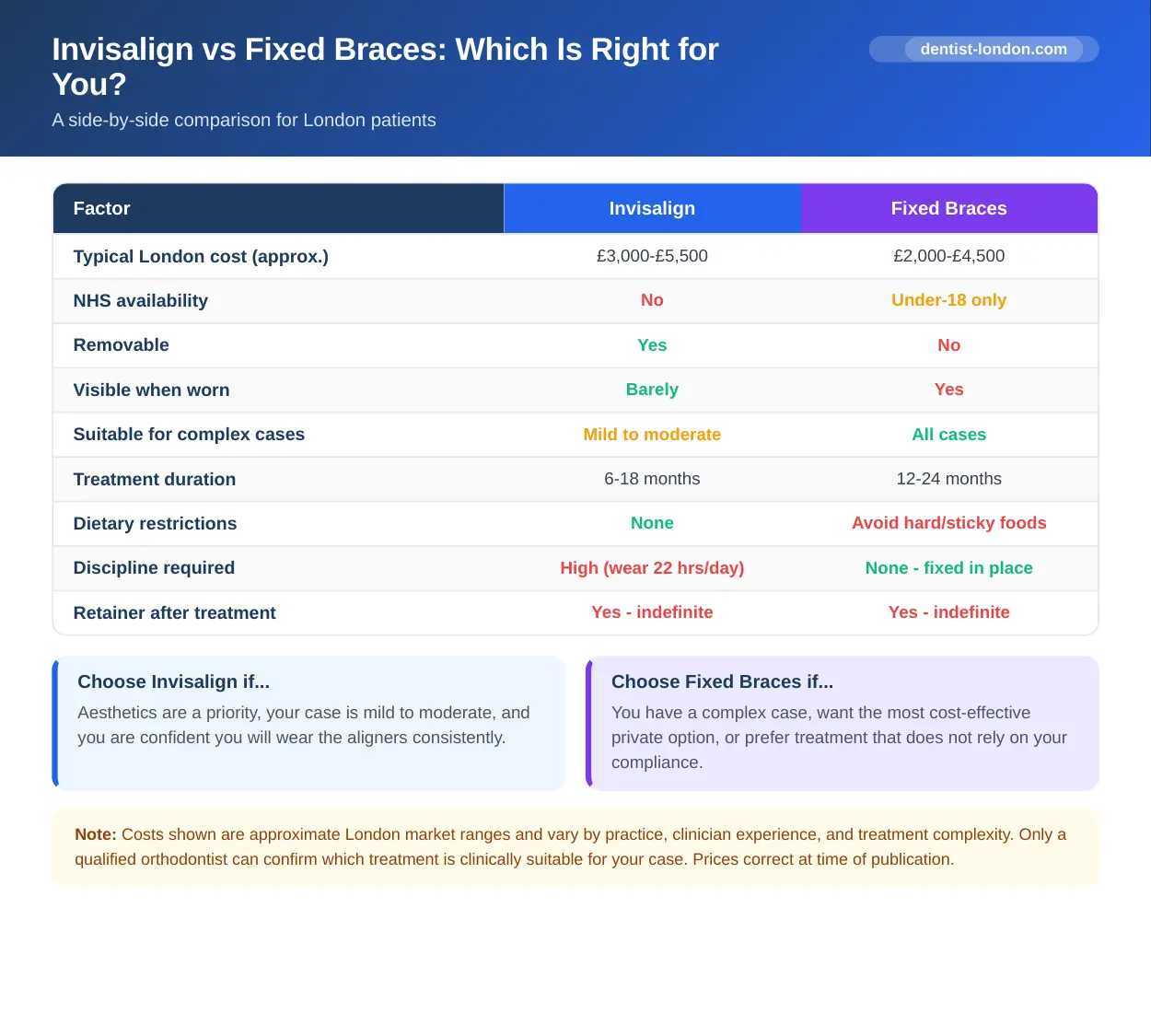
How Each System Works
Fixed Braces
Fixed metal braces — brackets bonded to the front of your teeth and connected by a wire — have been the standard orthodontic approach for decades, and for good reason: they work. The wire applies continuous graduated pressure, moving teeth into position over time. You visit your orthodontist every four to six weeks for adjustments, and treatment typically runs between 12 and 24 months depending on the complexity of your case.
Ceramic braces work on the same mechanical principle but use tooth-coloured or clear brackets, making them considerably less visible than metal. Lingual braces attach to the back surfaces of the teeth and are effectively invisible from the front — but they cost significantly more and are harder to adjust, which limits which practices offer them.
Invisalign
Invisalign uses a series of custom-made clear plastic aligners, each worn for approximately one to two weeks before progressing to the next in the sequence. Each aligner moves your teeth incrementally towards the final planned position. You remove them to eat and drink (except water), and to brush and floss, replacing them immediately afterwards. The aligners must be worn for at least 20 to 22 hours per day to be effective.
Check-up appointments are every six to eight weeks, though some practices now use remote monitoring apps to reduce in-clinic visits. Total treatment time ranges from around six months for minor corrections to 18 months or more for complex cases.
Which Cases Each System Handles Best
Fixed braces can treat virtually any orthodontic case — mild crowding, severe misalignment, complex bite corrections, and cases requiring significant vertical tooth movement. They apply force continuously and give the clinician more direct control over tooth position, which is why orthodontists prefer them for complex cases.
Invisalign has improved dramatically over the past ten years and now handles a much wider range of cases than it could when it launched. However, it has limitations. Cases involving large bite corrections, significant rotation of individual teeth, or severe crowding may still be better managed with fixed braces. An honest assessment from a clinician who offers both — not just one — is the best starting point.
Cost in London
This is where the decision becomes concrete for most people.
- Metal fixed braces: £2,000 to £3,500 for a full course
- Ceramic braces: £2,500 to £4,500
- Lingual braces: £5,000 to £8,000 or above
- Invisalign (full): £2,500 to £5,500 depending on case complexity
- Invisalign Lite (for minor corrections): £1,800 to £2,800
NHS orthodontic treatment — which uses fixed braces — is available for under-18s who meet the clinical criteria assessed using the Index of Orthodontic Treatment Need. It is not routinely available for adults. Most adult patients pay privately regardless of which system they choose.
Lifestyle Factors
Appearance During Treatment
Invisalign’s clearest advantage is aesthetic. Clear aligners are virtually invisible in everyday situations, which matters to many adults — particularly those in client-facing roles or who are self-conscious about wearing visible braces. Metal braces are immediately noticeable, though many people find they mind them less than expected once treatment is underway. Ceramic braces offer a middle ground.
Eating and Drinking
With fixed braces, certain foods are restricted or require cutting up — hard foods can break brackets, and sticky foods get lodged in the wire. With Invisalign, you remove the aligners before eating anything except water, so there are no dietary restrictions. You do need the discipline to replace them immediately after eating.
Cleaning Your Teeth
Invisalign makes dental hygiene straightforward — remove, brush normally, clean the aligners, replace. Fixed braces require careful cleaning around brackets and wires with interdental brushes. Poor hygiene with fixed braces carries a real risk of decalcification marks and plaque build-up around brackets that can take years to fade after treatment ends.
The Compliance Factor
This is Invisalign’s primary vulnerability. Aligners only move teeth if they are actually worn. Patients who repeatedly remove them for social occasions, forget to replace them, or lose aligners will find their treatment extended or results compromised. Fixed braces require no compliance — they work continuously, regardless of the patient’s habits or motivation on any given day.
Making the Decision
If your clinician recommends fixed braces for clinical reasons, that recommendation deserves weight — they have looked at your teeth, your bite, and your X-rays. If you have a genuine clinical choice and appearance during treatment is your priority, Invisalign’s premium is worth considering for most adults. If you have any doubt about your own compliance, fixed braces will produce more reliable results.
The best starting point is a consultation with an orthodontist or dentist who offers both options and has no commercial reason to push you towards one. Browse our London dentist directory to find practices offering orthodontic consultations.