



Published 27 February 2026
Diabetes affects your oral health more directly than most people realise. The connection between blood sugar control and gum disease is well established clinically, and people with diabetes are significantly more likely to develop serious periodontal disease. Yet when it comes to free NHS dental treatment, the rules may not be what you expect.
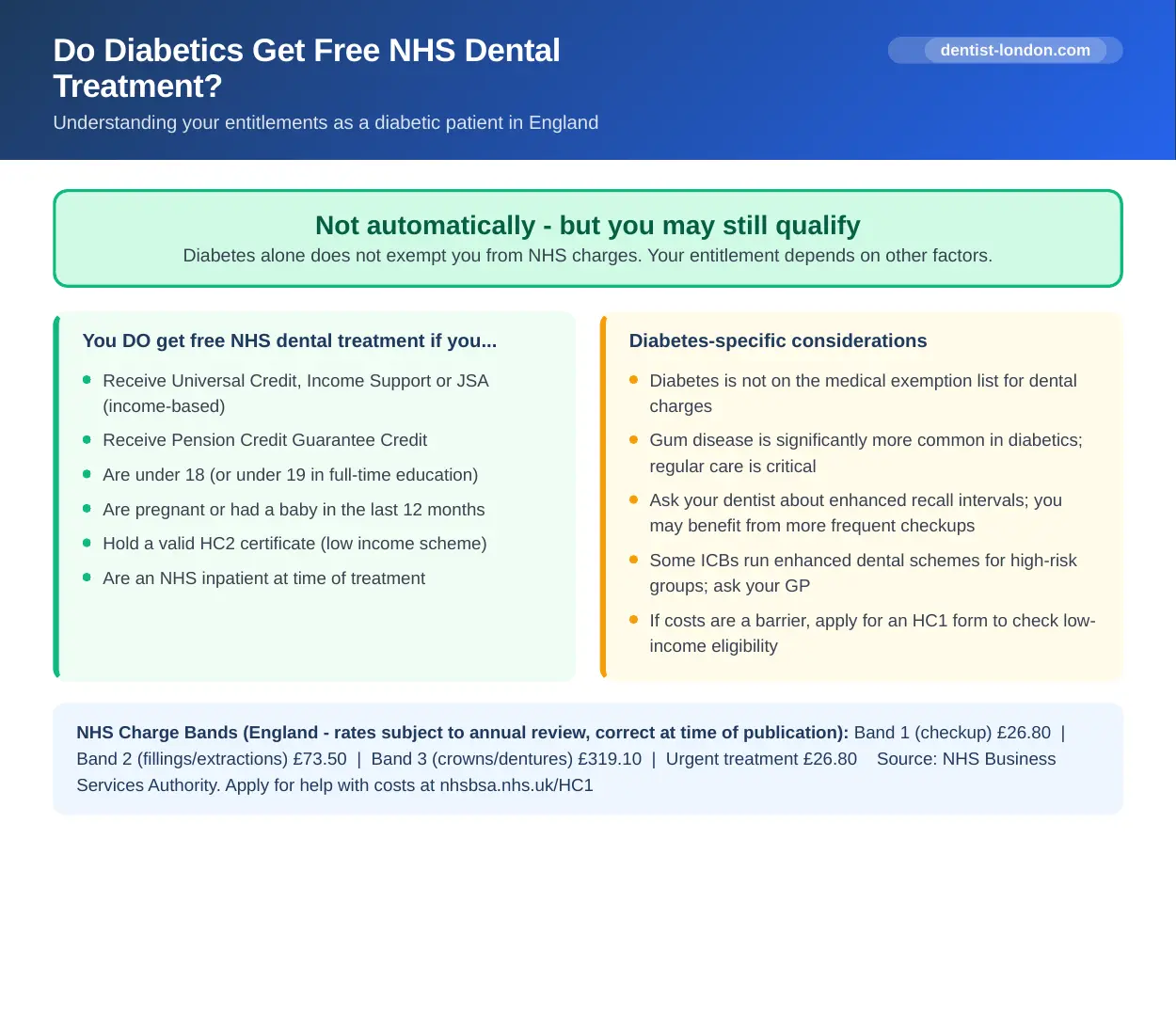
The Short Answer
Diabetes alone does not entitle you to free NHS dental treatment. Unlike some medical conditions — certain cancers, epilepsy, and a small number of others — diabetes is not on the NHS list of conditions that provide automatic exemption from dental charges. This surprises a great many patients.
However, there are circumstances in which people with diabetes may qualify for free or reduced-cost dental care through other routes. Understanding how those routes work can make a meaningful difference.
Who Does Qualify for Free NHS Dental Treatment
The NHS exemptions from dental charges are based on income and specific clinical circumstances, not on diagnosis of a chronic condition. The groups that qualify automatically include:
- Children under 18 (under 19 if in full-time education)
- Pregnant women and those who have given birth in the past 12 months
- People receiving Universal Credit (with no earnings or earnings below a threshold)
- People receiving Income-related Employment and Support Allowance
- People receiving Income Support or Income-related Jobseeker’s Allowance
- People receiving Pension Credit Guarantee Credit
- NHS Low Income Scheme (HC2 certificate) holders
Diabetes does not appear in this list. The exemptions are income-based and circumstance-based, not condition-based in most cases.
Why Dental Health Matters So Much With Diabetes
The Two-Way Relationship
Research consistently shows a bidirectional relationship between diabetes and periodontal disease. High blood sugar promotes bacterial growth in the mouth and reduces the body’s ability to fight infection, making people with diabetes significantly more susceptible to gum disease. Conversely, serious gum disease can make blood sugar harder to control, because the infection creates systemic inflammation that affects insulin sensitivity. It is a cycle that reinforces itself if either condition goes unmanaged.
People with poorly controlled Type 2 diabetes are estimated to be two to three times more likely to develop serious gum disease than people without diabetes. For those with Type 1, the risk depends significantly on how well glucose levels have been managed over time.
Other Oral Health Effects of Diabetes
Beyond gum disease, diabetes is associated with dry mouth (which increases cavity risk), slow healing after dental procedures, a higher susceptibility to oral thrush, and taste disturbances. Dentists who know a patient has diabetes will monitor for these issues and may adjust their treatment approach — for example, being more cautious about timing extractions in relation to blood sugar levels.
Tell your dentist you have diabetes at your first appointment, and keep them updated on your current HbA1c and how well your diabetes is managed. This is clinically relevant information, not just background.
Routes to Reduced or Free Treatment
The NHS Low Income Scheme
If you are on a low income but do not receive qualifying benefits automatically, you can apply for an HC1 form through the NHS Business Services Authority (available online). If you meet the income criteria, you will receive an HC2 certificate entitling you to free NHS dental treatment, or an HC3 certificate providing partial remission. The application asks about your income and regular outgoings, and the threshold is not as low as some people assume.
Qualifying Benefits
If diabetes or related health complications have affected your ability to work, and you receive qualifying means-tested benefits as a result, you may already be entitled to free dental treatment without realising it. If you are uncertain, the NHS Business Services Authority has an online eligibility checker that takes around five minutes.
Dental Schools
Dental schools in London offer treatment at significantly reduced rates. King’s College London Dental Institute, UCL Eastman, and Barts and The London all provide clinical training facilities where qualified students carry out treatment under close supervision. Waiting lists are longer, and appointments take more time, but the cost saving for patients who need significant dental work can be substantial.
How Often Should People With Diabetes See a Dentist?
The NHS does not mandate a specific frequency, but many dentists recommend more frequent hygienist appointments — three to four-monthly rather than six-monthly — for patients with active gum disease or poorly controlled blood sugar. If your dentist recommends a shorter interval between appointments, that recommendation is clinically grounded.
Regular attendance is genuinely important for people with diabetes — not just for your teeth and gums, but as part of managing your overall health. If cost is a barrier, exploring the eligibility routes above is well worth the effort.
NHS exemption criteria and benefit rules are set by NHS England and the DWP and may be updated. Check NHS.uk for current information on who qualifies.